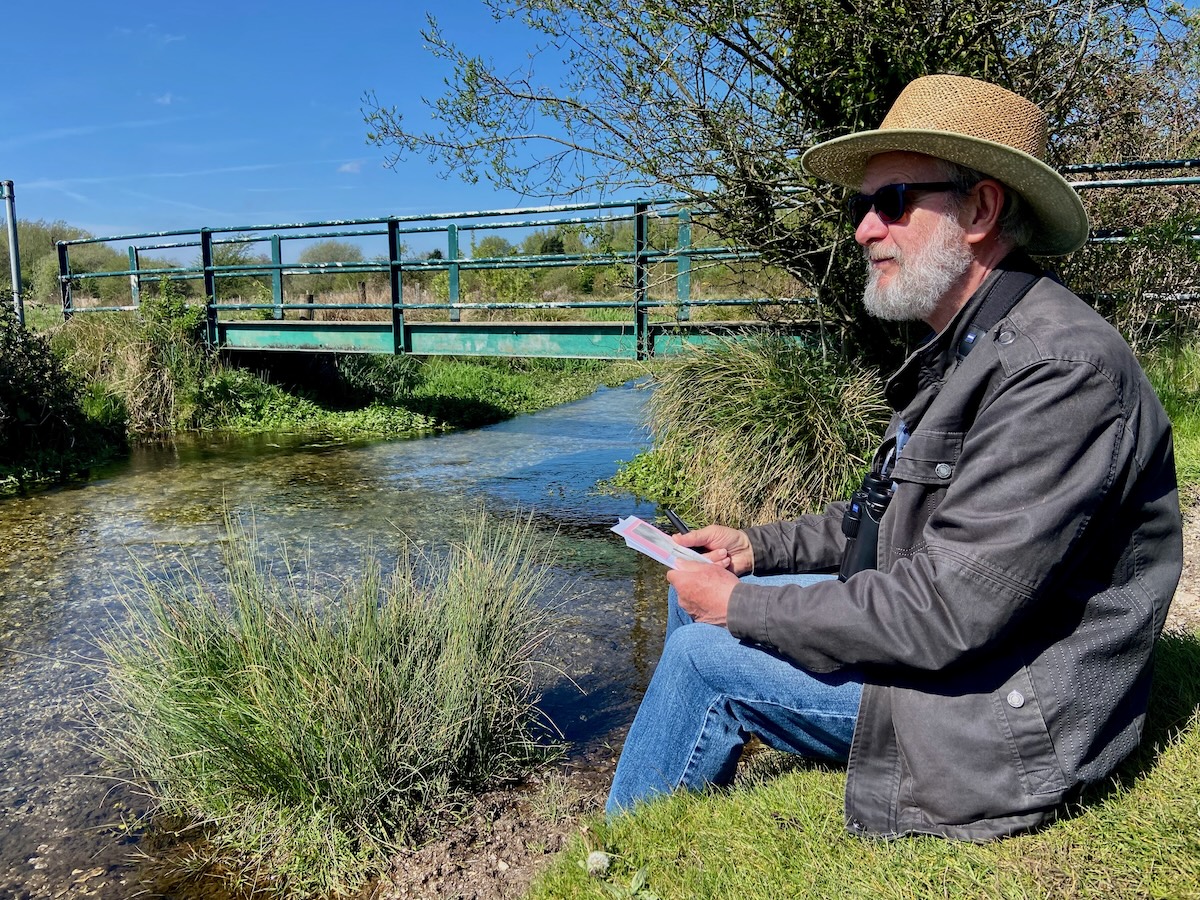
Last week I took a walk with Peter Driver, a fellow artist and birder, who I first met and exhibited with when I was an Associate Artist with CAS (Chapel Art Studios) in Andover around 10 years ago. Peter lives in Mortimer, a village in Berkshire edged by the Foudry Brook, a tributary of the River Kennet and not far from Reading (see this earlier Queer River walk with Tim Sykes by the Kennet), .
‘Working from his studio on a farm in West Berkshire, he occupies himself with printmaking, painting and scouring the local landscape for signs and wonders: a variety of responses to the beauty and brokenness of living in the world. He makes things, or makes things happen, primarily for aesthetic reasons; often incorporating pop culture, memory and natural forms to ‘sing into the void’ about the climate and nature crises and the common good.’
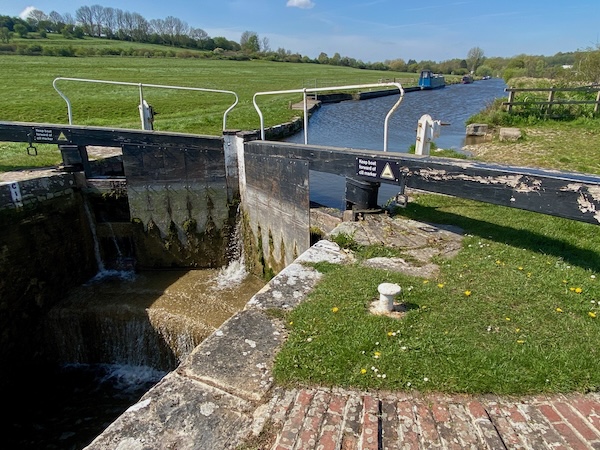
When I first contacted Peter about meeting up for a catch up and a Queer River walk, we wondered together where to meet. My two local rivers are now the headwaters of the Salisbury and Bristol Avons. As the Kennet and Avon Canal runs between Peter and I, connecting the Bristol Avon to the Kennet, that seemed like a good place to start, and Hungerford was roughly in the middle.
I lived near the Kennet in the early 2000’s when my husband and I first moved back to Marlborough from Brighton, and although not now my local river, I’ve been planning on getting across to spend more time with it again. When I lived in Marlborough I worked on a couple of community engagement projects with ARK (Action for the River Kennet), the Rivers Trust for the Kennet and Pang catchments, and keep up with their work online.
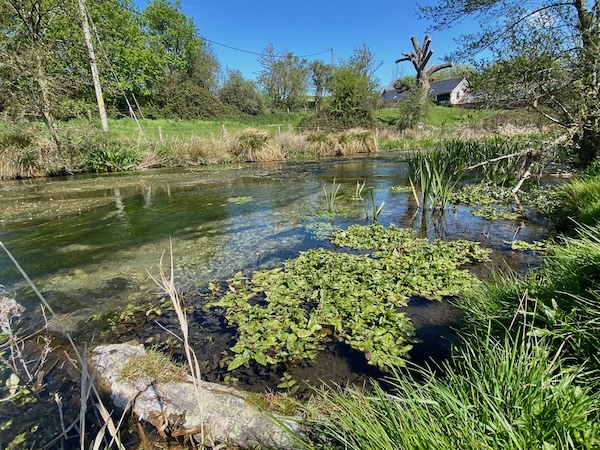
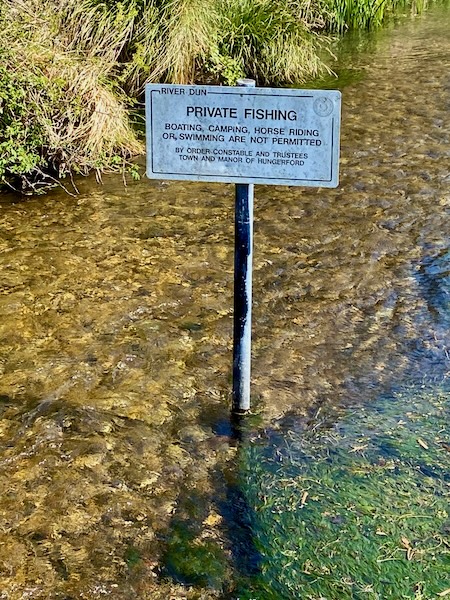
In the end we focused on a smaller tributary of the Kennet, the River Dun, a gorgeous little chalkstream that runs begins in the Great Bedwyn area and joins the Kennet near Hungerford. The origins of the name Hungerford are apparently Saxon, meaning ‘ford leading to the poor lands’. We didn’t know this at the time, but land ownership, economic inequality and access to both land and rivers became a key thread within our conversation as we walked together.
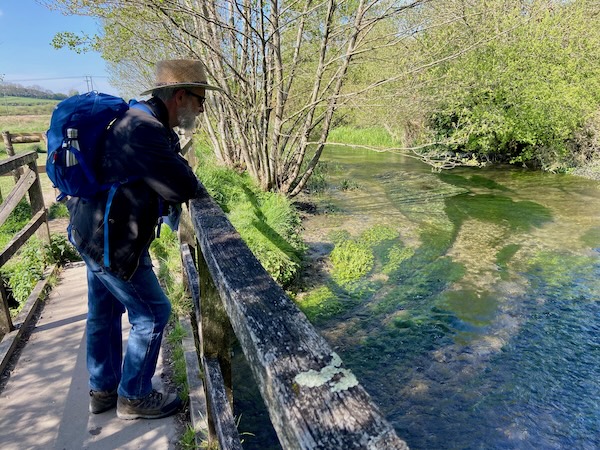
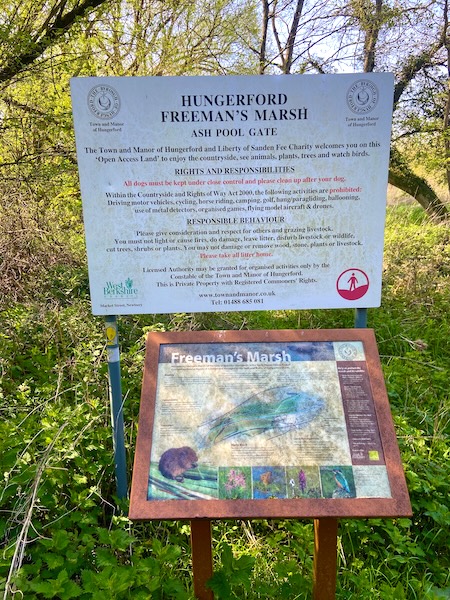
I had made some simple, collaged cards to record our conversation onto and offered a few to Peter. As we followed the canal and then the Dun out of Hungerford, we entered an area called Freemans Marsh, a 72 acre site owned by the Town and Manor of Hungerford and Liberty of Sanden Fee, a charity that describes its aims as being to protect ‘the beautiful countryside, and a wonderful ancient set of rights, for the Commoners and people of Hungerford’. As we walked and talked we were surrounded by birds calling from the willows and scrub; Sedge, Cetti and one Grasshopper Warbler, Blackcaps, Wrens and Linnets. Peter shared with me some of the rhymes and stories he first used to identify and remember each bird’s song, for example. a Goldcrest counting its gold, calling out rapidly 1 and-a 2 and-a 3 and-a 4 and-a 5 Million! Similarly my Dad told me that that Wood Pigeons repeatedly chant I do love Lucy, I do love Lucy over and over again.
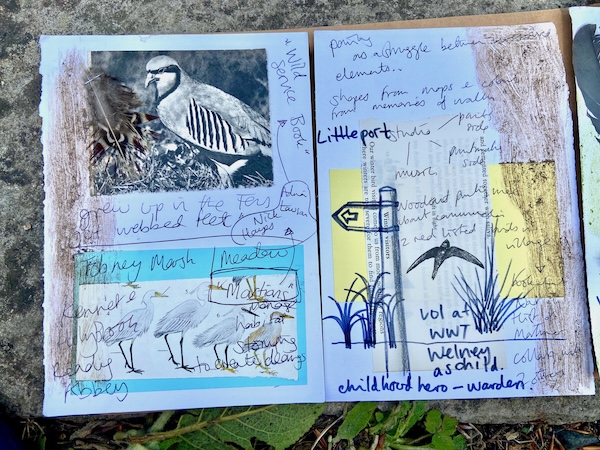
Peter grew up in the fens of Cambridgeshire and can clearly remember when his fascination with birds and birdwatching began. Riding on a bus as a boy he looked out of the window and saw a Lapwing, with its crest blowing in the breeze. One of his favourite birds ever since, the sighting of the Lapwing led to him looking the bird up in his Dad’s Observer Book of Birds, and all the other birds he found there, soon receiving bird books himself as gifts from family, and going on to work at the Wildfowl and Wetlands reserve at Welney.
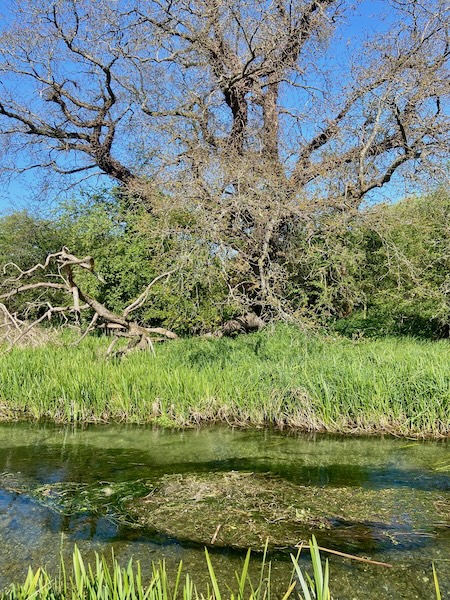
The fens were largely drained in the 17th Century, with the Duke of Bedford and others taking land for themselves and making money for the King, by hiring the Dutch engineer Cornelius Vermuyden to design a drainage system that removed the water (and the wildlife that depended on it), exposing the rich peaty soil for agriculture.
The local villagers were fiercely opposed to the draining, believing it would deprive them of their traditional means of livelihood from wildfowling, fishing and reed cutting and would replace the fenland with arable land owned by strangers. The “Fen Tigers” tore down the dykes, ditches and sluices that had just been built and set the reedbeds on fire, so stopping work. But by the end of the 17th Century much of Vermuyden’s hugely ambitious project had been completed, with the Bedford River and New Bedford River carrying water more quickly northwards to the Wash.
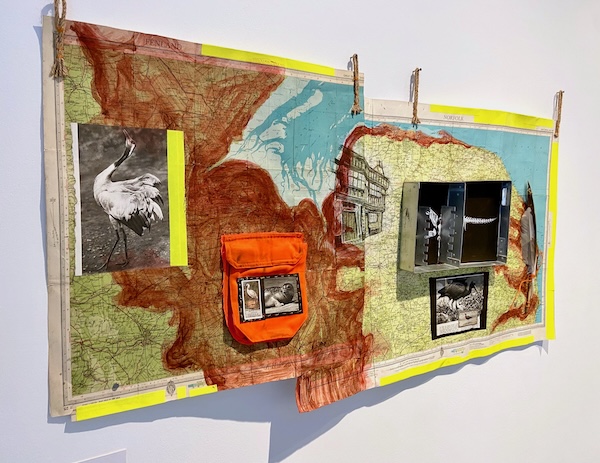
When I was carrying out an extraction-themed residency with Groundwork Gallery in Kings Lynn back in 2024 I read up on the drainage of the fens, as well as the historic hunting of wetland birds for their feathers, and beavers for their meat and castoreum, and created a wall-based installation exploring the past and potential future of the area, titled ‘The Beaver and the Whale’ (see photograph of detail below).
One thing that gives me hope amongst the legacy of wetland drainage and extraction is the potential for rewilding and rewetting, from The Great Fen project, (‘an ambitious 50-100 year habitat restoration project, with 14 square miles of land restored to wild fen‘) to the potential future reintroduction of the Dalmatian Pelican, and the success of the reintroduction of the Eurasian Crane to the Somerset Levels. If this is your kind of thing, I’ll be contributing to a panel at a Water themed Into the Light at Heal Somerset this coming June, a rewilding gathering where I imagine there will be loads of people bringing a sense of Active Hope through regenerative land/water practices.
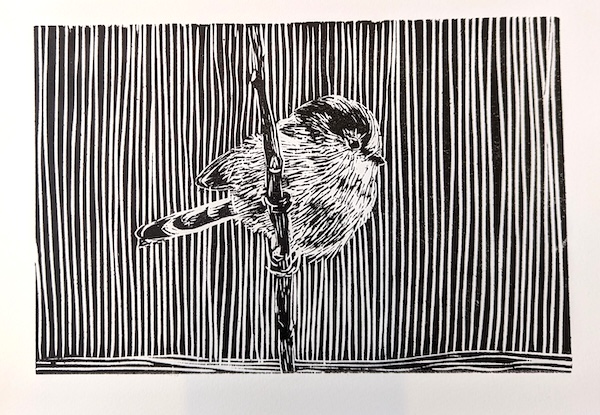
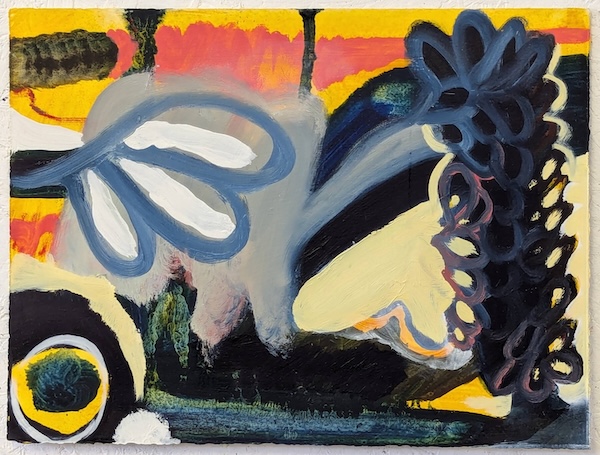
Some of Peter’s artwork directly references his love of birds and birding and some doesn’t. Birds have a stronger presence in Peter’s printmaking, but less so in his painting, although as he shared with me, a painting can sometimes include visual elements from his walks . A new project of Peter’s seeks to record 100 bird species within the parish boundary of Mortimer during 2026, and to create twelve woodcut prints of the red listed birds living there, starting with the Lapwing. These will feed into a new book with two collaborating artists/friends (the poet John Froy and artist, naturalist and writer Geoff Sawers), following on from Peter’s two previous books, A Walk for Stanley (a three-day, 39 mile walk from the Stanley Spencer Gallery in Cookham to the Sandham Memorial Chapel) and Widdershins Walk (another collaboration with Geoff Sawers completing an anti-clockwise route around the circumference of Reading, divided into five walks over the four seasons of 2024).
I’ve written previously about my interest in birdwatching and the ways that people record and respond to the birds that they notice (see the post How Do I Notice Birds?), including the relationship between birdwatching and neurodivergence. My Neuroqueer Ecologies research focuses on the value of sensory differences for ecological understanding, for example in noticing bird song or visual detail within a particular ecosystem.
I’m also fascinated by the personal histories that bring people to give their attention to particular plants or animals, like Peter’s Lapwing experience. As a child I visited the Wildfowl and Wetlands Trust Slimbridge reserve regularly with my Dad (who had his own watery passions including sailing), and took holidays with him on the Norfolk Broards, where I would fish with my brother and feel safe and happy moored out on the water surrounded by swans, geese and ducks. At home as a small child I had a copy of Tony Soper’s Bird Table Book from which I drew pictures of the birds inside, an Encyclopaedia of Animal Life which fed my enthusiasm for animal facts, and Gerald Durrell’s The Amateur Naturalist which gave practical advice of collecting and preserving specimens (e.g. dissecting owl pellets).
Back in Hungerford, Peter told me about a new Kennet Valley Wetland Reserve, which has now gained planning permission, and is due to be created over the next couple of years. ‘A centre of excellence for wetland ecology, environmental education and public recreation’, the Reserve will also offer flood relief to the town, seek to capture carbon through wetland creation and provide a new base for ARK (Action for the River Kennet).
Peter has been involved in grassroots forms of wetland habitat creation closer to home, through the work of the Marshians community on Fobney Marsh near Reading (see more about the Marshians here on Adrian Lawson’s Rural Reading blog). The Marshians came together, without the landowner’s permission as a form of mass trespass, to create a wider range of habitats at Fobney, from the communal stomping of reeds and bullrush to create clearings, to clearing rubbish and – after asking ‘what would a beaver do?” – experimenting with different forms of leaky dams or Beaver Dam Analogues, to keep the marsh wet for wildlife.
As we continued our walk we talked about the work of the Trespass Movement, some of which we agree with and some not, and our various connections with it. The Book of Trespass was key in informing my understanding of the history of land ownership and financial privilege in the UK. The author Nick Hayes lives in the Reading area, and is a friend of the Marshians movement. The Marshians leader Adrian Lawson appears in Nick’s book Wild Service: Why Nature Needs You, while I appear in its predecessor, The Trespasser’s Companion.
You can read an interview here with Nick Hayes, on a trespass that he and others led onto the Englefield Estate back in 2022. The Estate owns most of the woods and farmland around Peter’s village in rural Berkshire. His studio is on one of the estate farms, and the owner Lord Benyon of Englefield is also the patron of the proposed Kennet Valley Wetland Reserve. Peter admitted that he appreciated the Estate allowing open access to its woodlands, and the network of paths across the area. My and Peter’s conversation also took place the day after I had listened to the Absolute Units podcast from the MERL (Museum of English Rural Life) titled Who Owns England? with Guy Shrubsole, another member of the Trespass Movement and the author of a book and blog of the same name, that sought to uncover the truth about who owns were (you can also read about my involvement in the Queer Constellations exhibition at the MERL in this previous post).
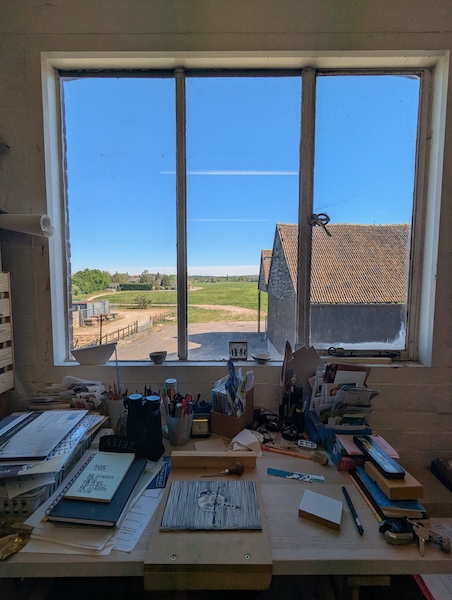
It’s a bit on a tangle of connections. My conversation with Peter was one of those where the more we talked, the more connections were uncovered, and I’m sure that still more lies just beneath the surface ready to be unearthed. From land ownership, commoning and trespass, to wetland creation and restoration, to the construction and demise of the canal system and its relationship to slavery (see an earlier walk here with Andy Marks). And the birds of course, along with the other animal and plant species that hang on in there (or fade away) as we humans develop and redevelop the land,
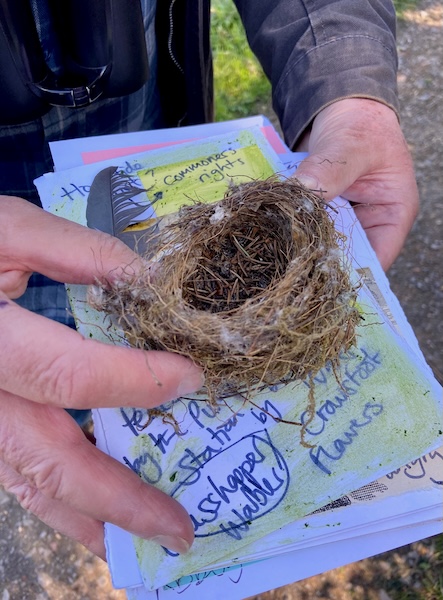
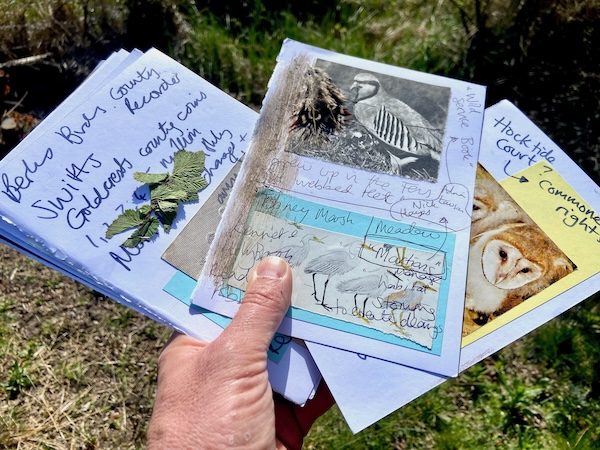
I said to Peter that I had wanted to walk together because I had respect for his work and its ethos, I feel a connection with the role that walking plays in his practice, his love of birds and his belief in equality and fairness, especially as a LGBTQIA+ ally. I was reminded as we walked of Andy Marks’ comment to me when we had walked along the Kennet and Avon Canal in Devizes, that through Queer River I am creating a community one conversation at a time. I’m thankful to have had the chance to walk and talk with Peter and to share our conversation here, and am looking forward to more Kennet wanders together soon.