
I’ve always been interested in animal tracks and signs, as a way of getting a glimpse into the lives of other animals. I feel like they give us a chance to communicate with other beings, if we are prepared to slow down, and notice/listen.

Back in 2014 I wrote a piece about my relationship with our previous dog Moshi and what we each noticed on shared walks for Dark Mountain issue 5:
‘Here in or between fields, guided by signs, my perception colludes with the farmer’s machinery as I follow mown lines and peer through fences. Here the constant ‘show and tell-er’ of what can pass across these lines is Moshi – hearing sounds and smelling smells I can only imagine – pointing out pathways in the verges and up under the hedge that I have learnt to recognize as a badger or fox, but which to her must be so much more.‘
I also wrote a blog post a while back abut the importance of slowing down in a time of crisis. Listening to what the more than human world has to tell us, rather than rushing about acting from a position of assumed understanding/superiority – Slowing Down, Going Deeper.
This last few weeks I’ve been spending a lot of time with our son and dog. Once my exhibition was up and running, there was a bit of work here and there and a week’s holiday in North Norfolk with my husband, but apart from that, I’ve been trying to find ways to meet the needs of a 12 year old boy and a 50 year old man (me) at the same time.

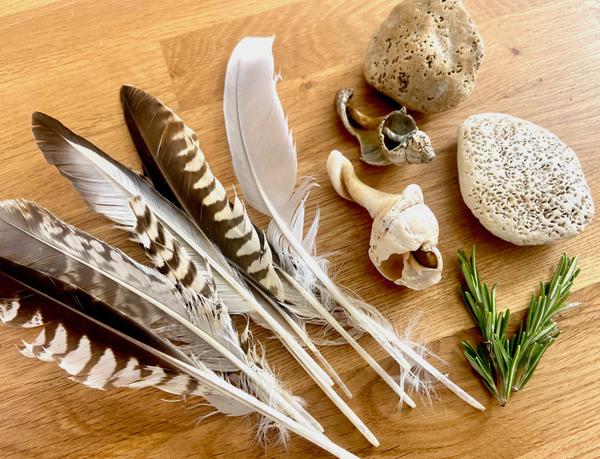
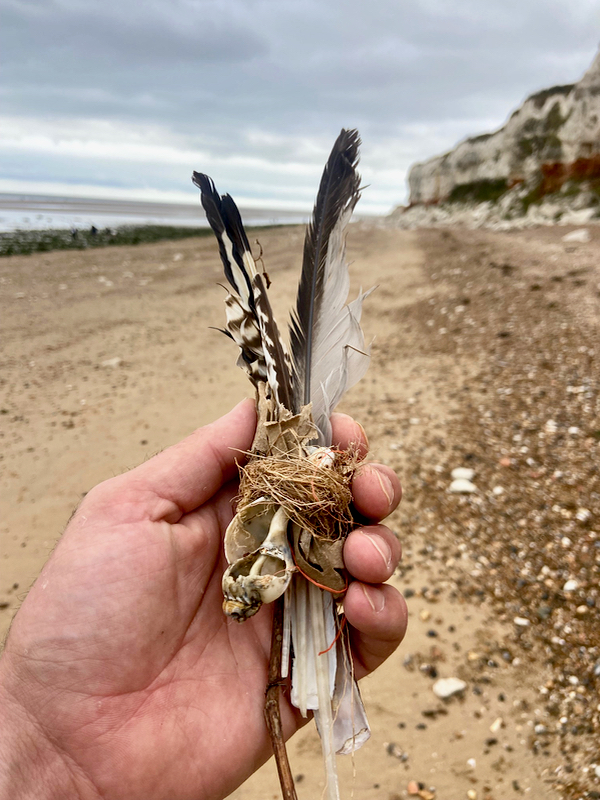
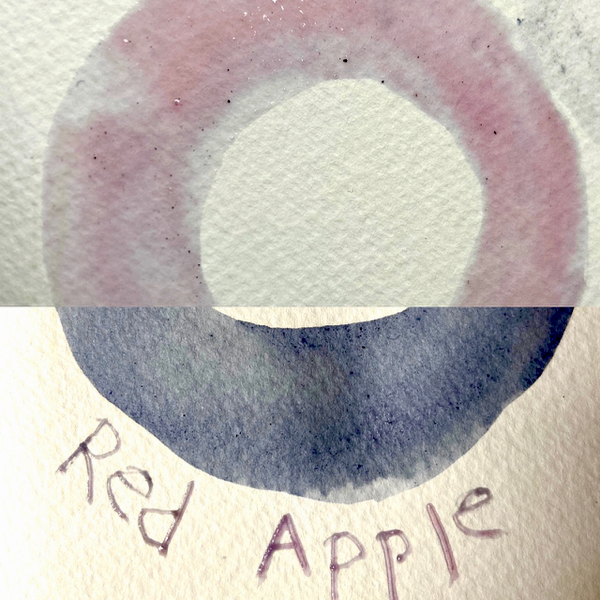
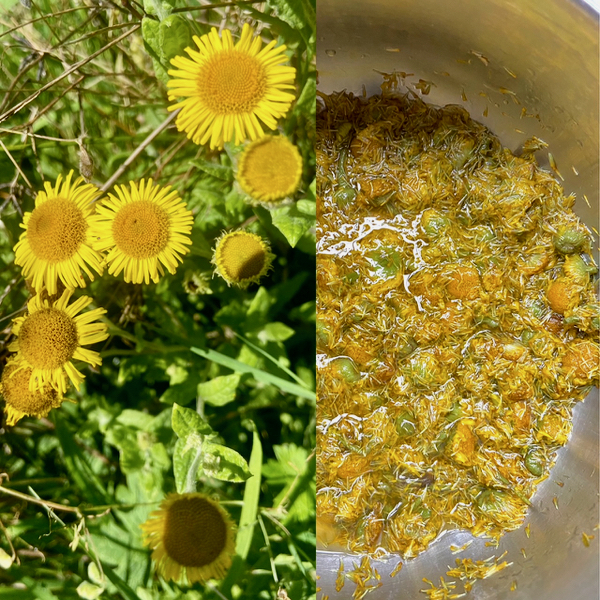
I’ve made small collections (see Collecting to Connect) while he practices tricks on his scooter, gathered material for making inks whilst on dog walks, and managed to visit the odd exhibition here and there, including The Ground Beneath our Feet at Groundwork Gallery, Kings Lynn.
It’s reminded me a bit of when we first adopted our boy, and then again in lockdown, when my arts practice shrunk to fit the spaces that we inhabited, keeping a kitchen sketchbook where I used what I could find in the spare minutes between meals and playing, or taking photos of the toys that found their way into bed and baths and onto cafe tables.


Today I made another small collection, focusing on colour (for about 5 minutes) whilst sat on the kerb at the end of our road. While I gathered together the few small finds and quickly arranged them, I started to think about these arrangements as equations.
To me a collection has mathematics in it, and seeks to find some kind of balance through the relationship of its parts. I can’t say much more than that at the moment as it’s a new realisation, but it’s similar to the way that I read animal tracks and footprints as a written language, a conversation in the mud.

I’ve always felt a deep connection with animals, and growing up would often be found with horses, ducks, woodlice or tadpoles, or laying on the floor with the dogs. Now I’m thinking about interspecies relationships/communication and their relationship with Neurodivergence.
I’m planning on carrying out some experiments in the coming weeks/months (as the school term starts) as part of my Neuroqueer Ecologies research. These will build on The Ash Looks Back series (made with camera traps hung on Ash trees). I’m not sure exactly what these will look like yet, in the past I’ve left half finished artwork in my compost bin and pond, for the organisms there to complete, and I imagine there will be a similar combination of my making and theirs.
My exhibition Drawing on Water at Pound Arts has just come down, so I also need to leave time and space to process all that has come out of that (I’m hope to edit together a short video tour of the exhibition for anyone that wasn’t able to make it).

Whether everyone else will see these interactions as conversations and collaborations I’m unsure, I’m expecting most people to see my offerings and recordings as more one-sided than that, but I want to continue to research what happens when we leave open the possibility that other beings are speaking to/with us.
Perhaps, as Peter Reason writes, if we open ourselves to that possibility, and really listen, we could receive insights that would otherwise be missing from our understanding of the world:
‘What would it be like to live in a world of sentient beings rather than inert objects? How would we relate to such a world? And what, then, would art and creativity be like? This a world of communication and interaction of which we can be a part, in which trees, crows, and rivers may grace us with a response to our attention and our call. Of course, we do live in such a world, although modern culture tragically fails to acknowledge this… If we open ourselves, if we call, the world will respond. The place of art is to foreground this perspective.‘
Peter Reason – On Sentience, with Sarah Gillespie
 Queer River
Thanks for the quote, James. I feel I could learn a lot from your quiet noticing and assembling. Of course they are conversations. I wonder, as you assemble your equations, do you also allow the things to select and assemble themselves?
LikeLike
Thanks Peter, I think the collection and assembly is two way… I’m definitely learning from them and I think they are asking to be noticed
LikeLike