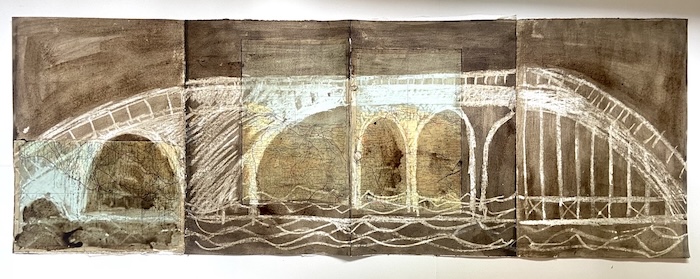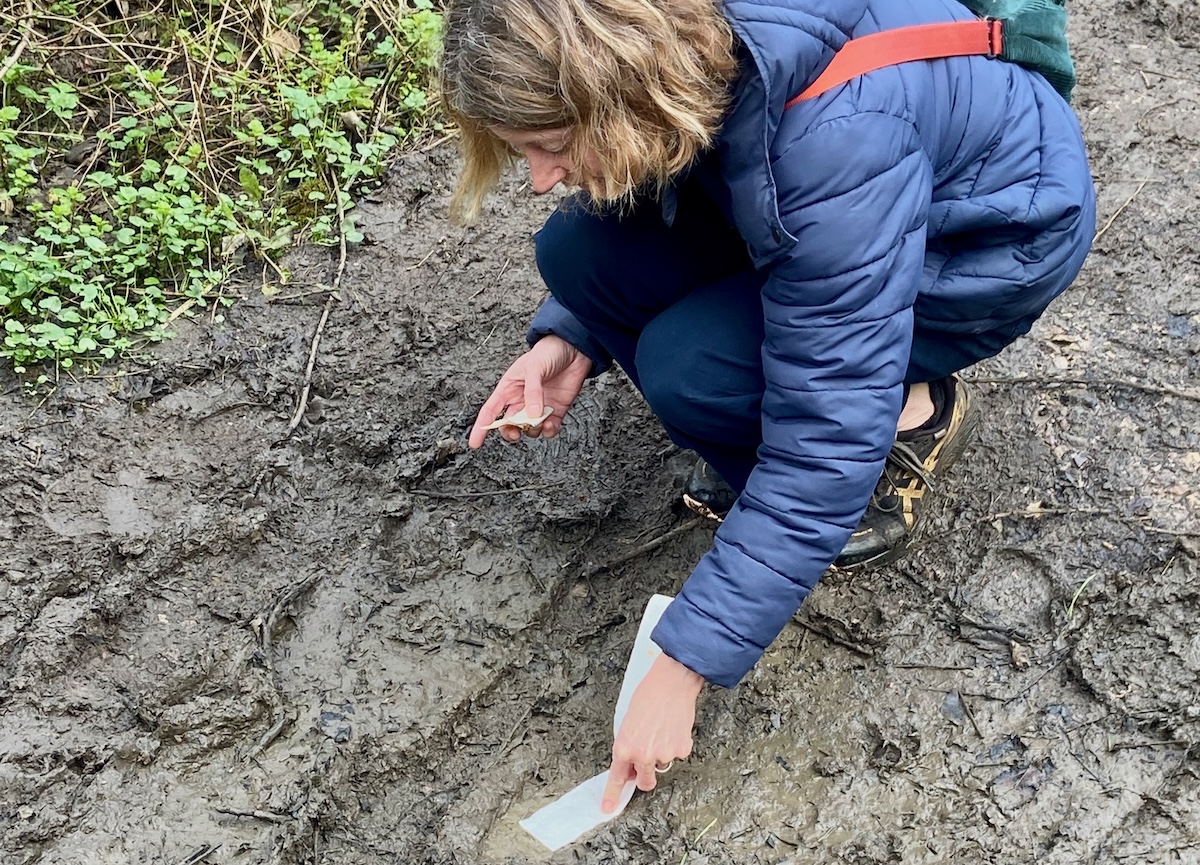
Walking Out

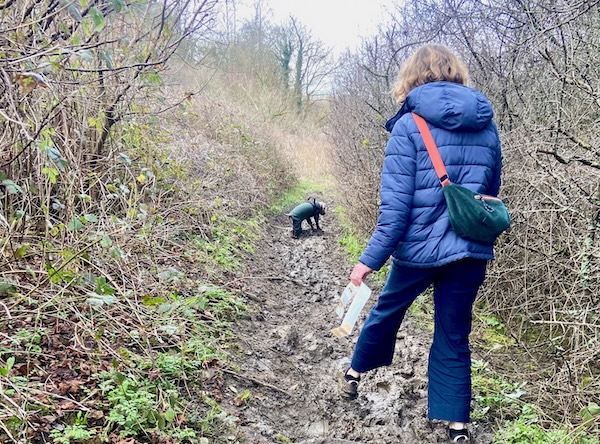
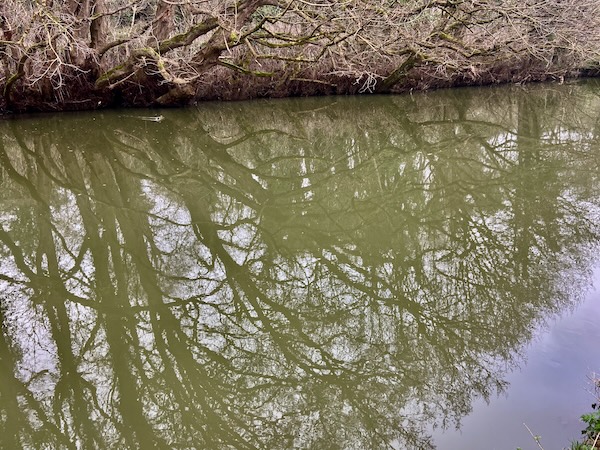
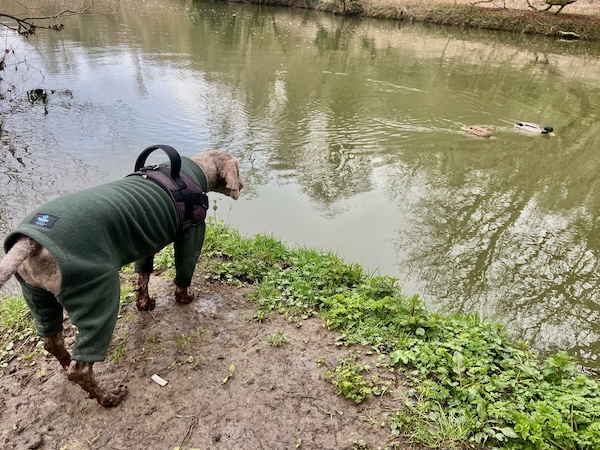
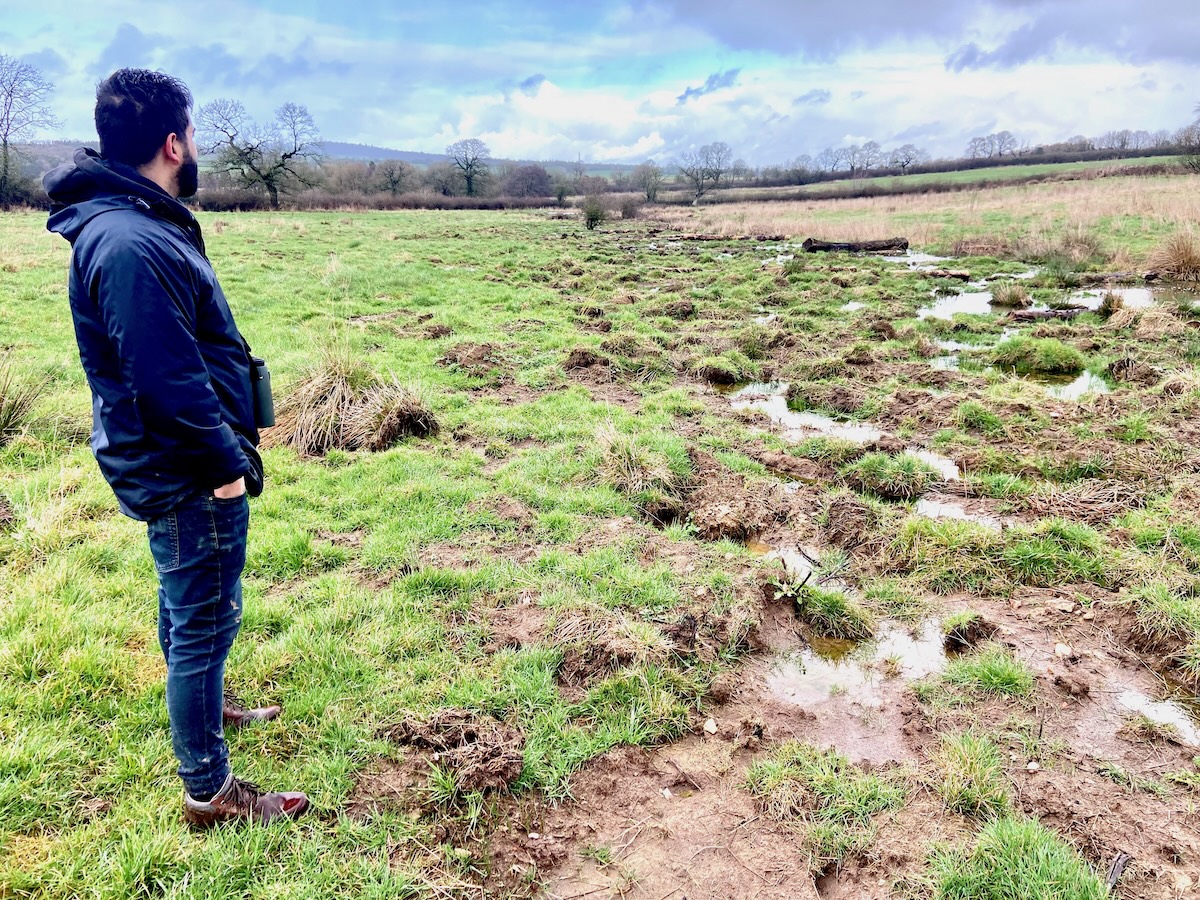
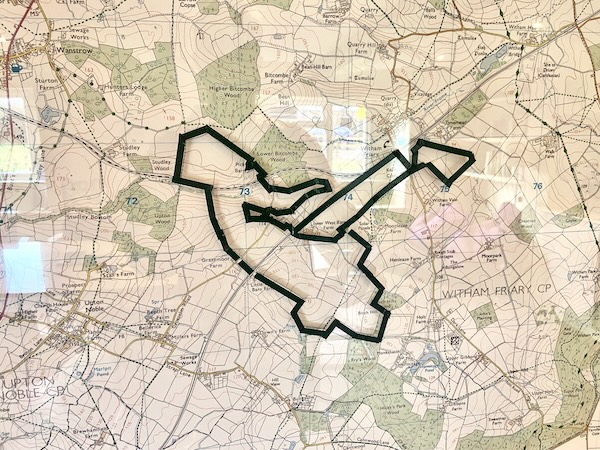
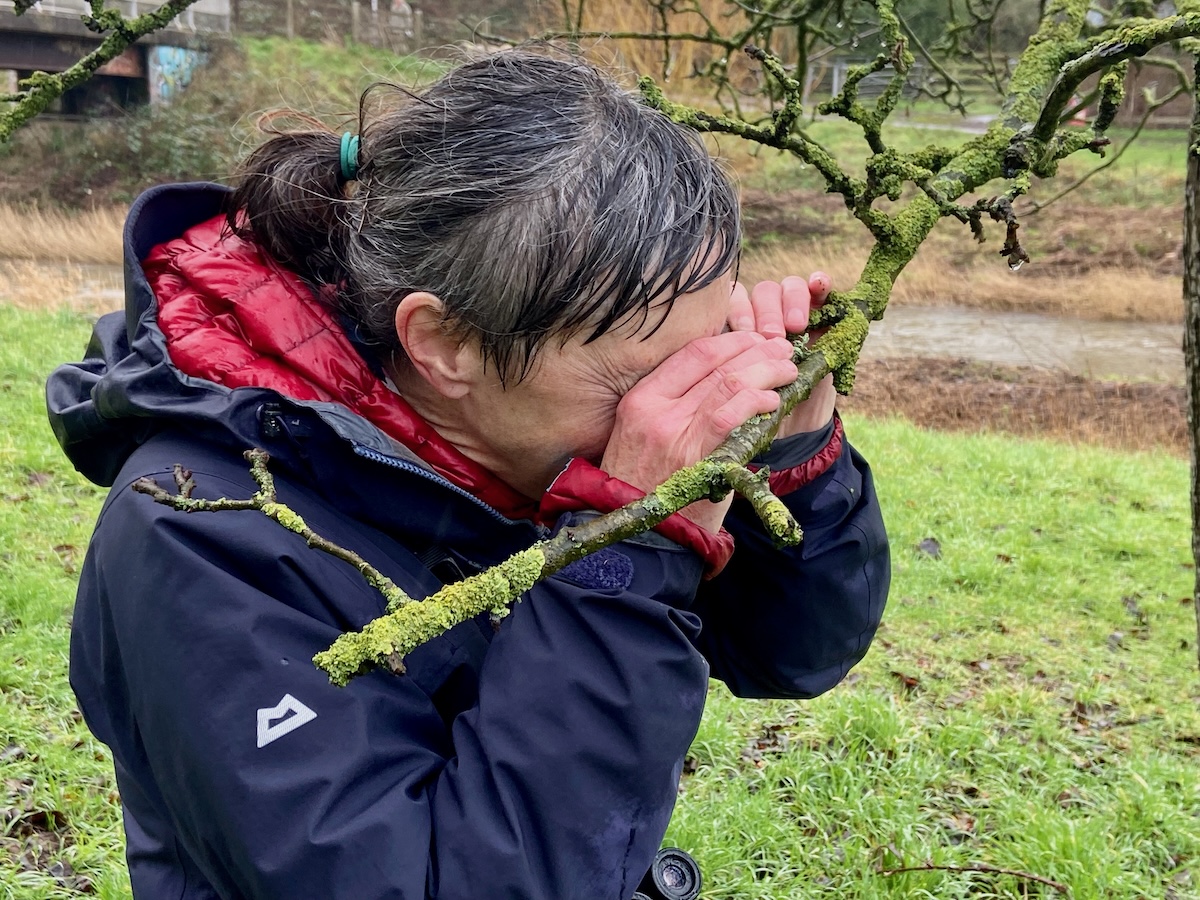
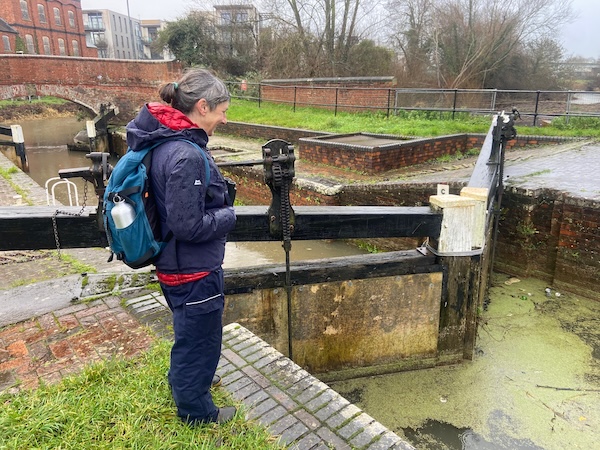
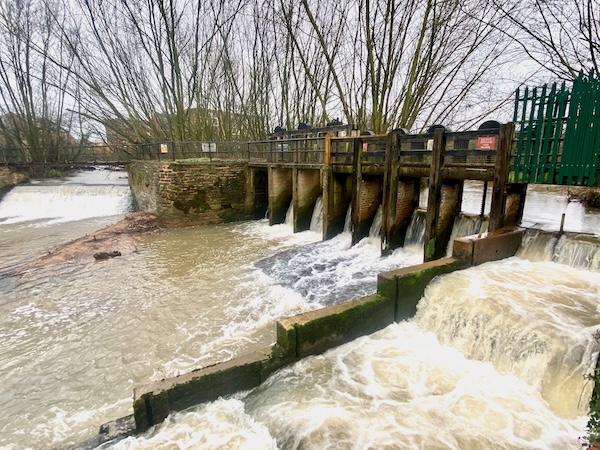
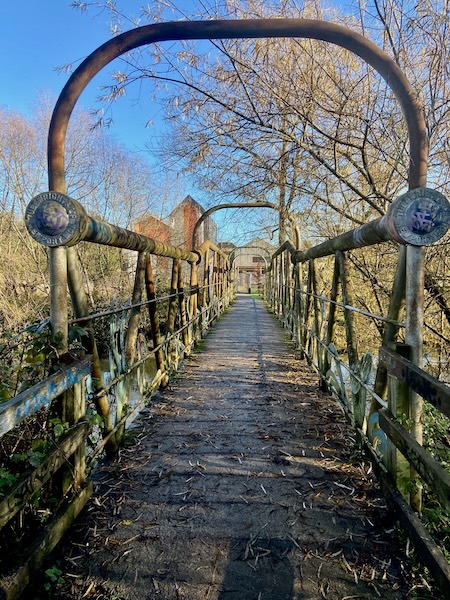
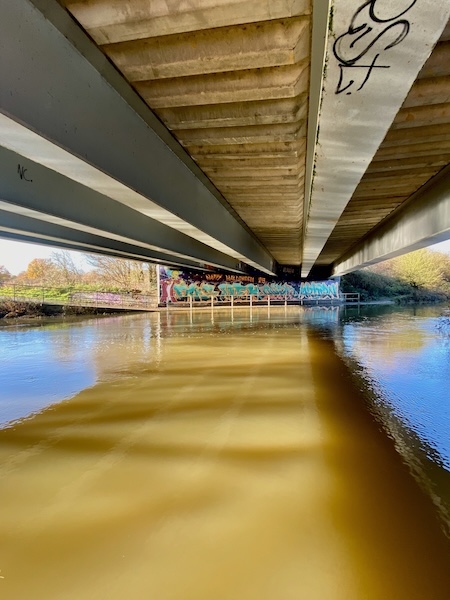
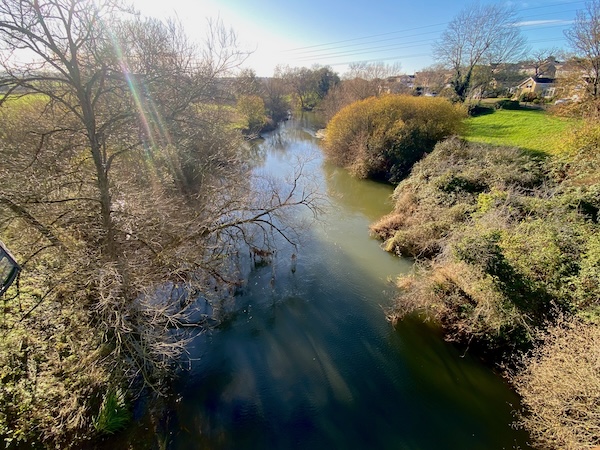
Over the last few months I’ve been parking up and walking out from some of the towns and villages sited along the Bristol Avon and its tributaries, as they run through Wiltshire. Although the Salisbury or Hampshire Avon runs nearest to my home in the Vale of Pewsey, the two watersheds meet only a few miles away from here, with streams on ‘the other side’ feeding the Semington Brook and other Bristol Avon tributaries.
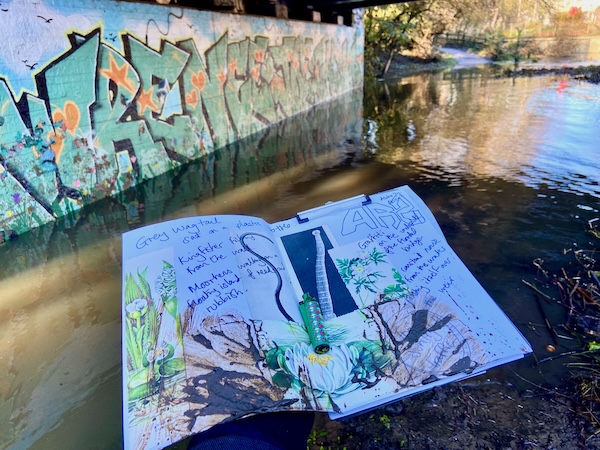
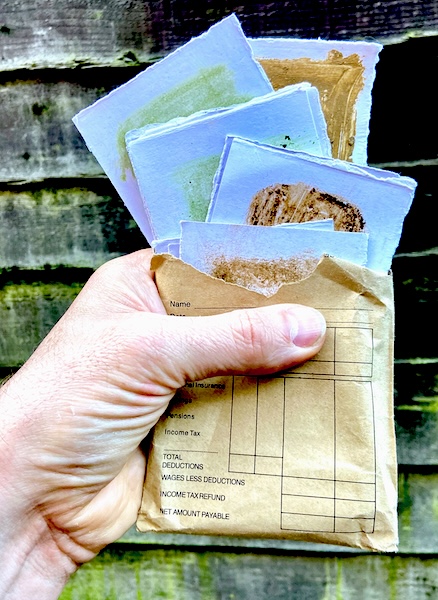
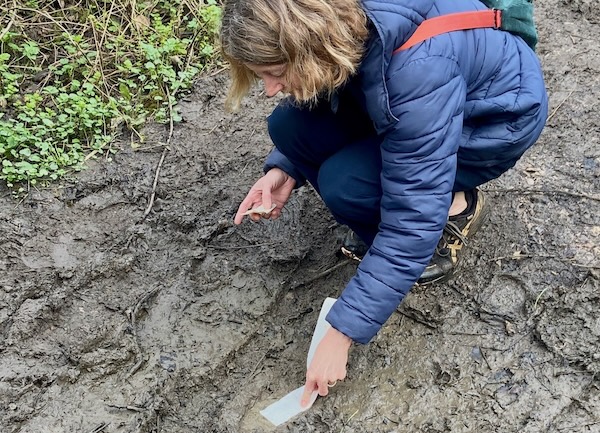
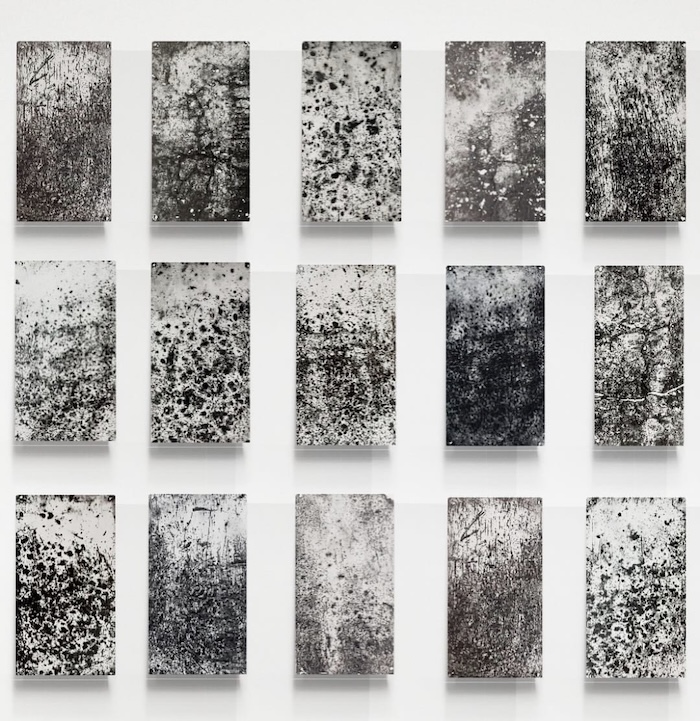
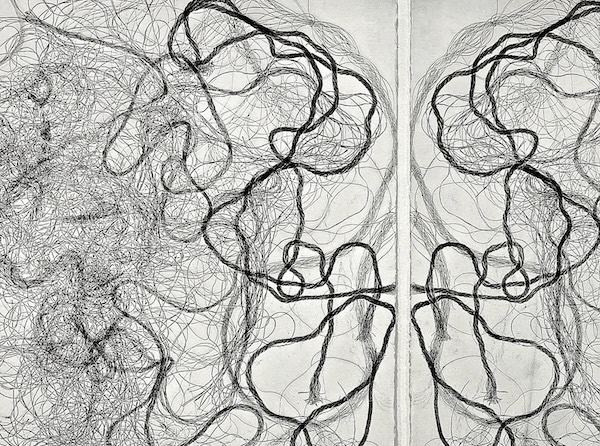
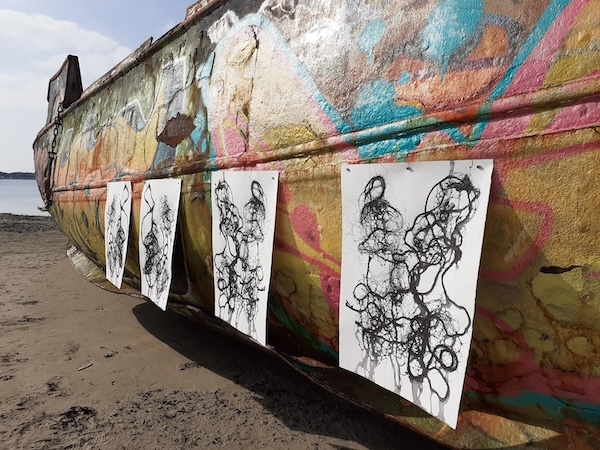
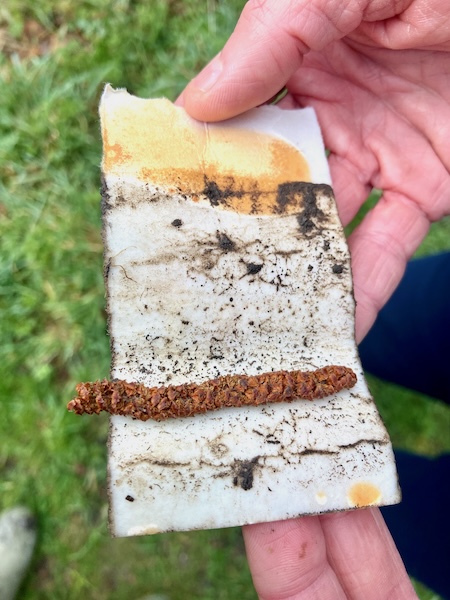
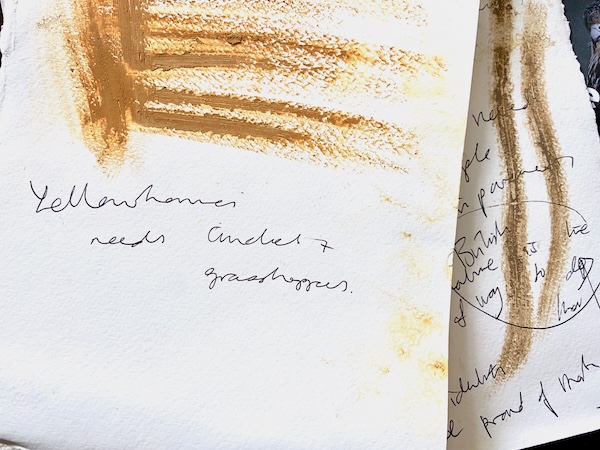
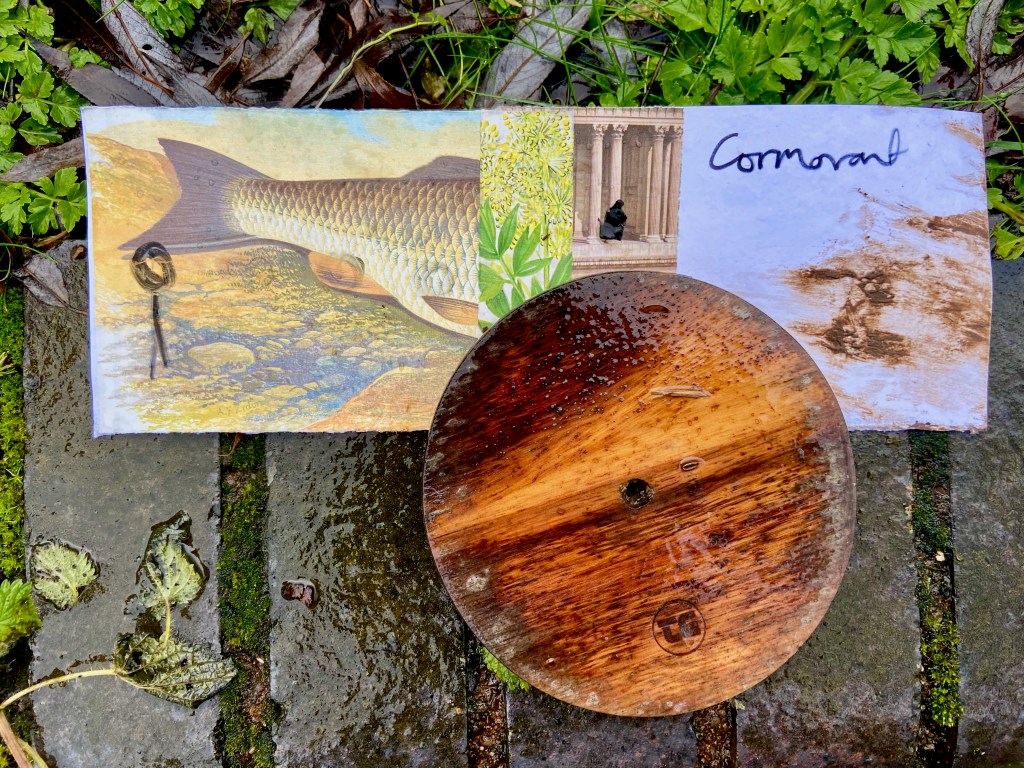
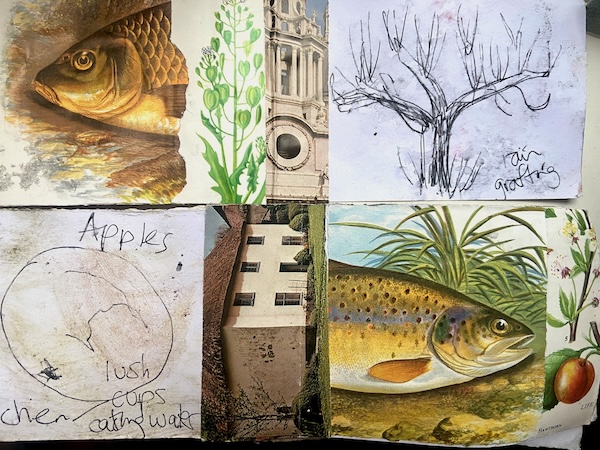
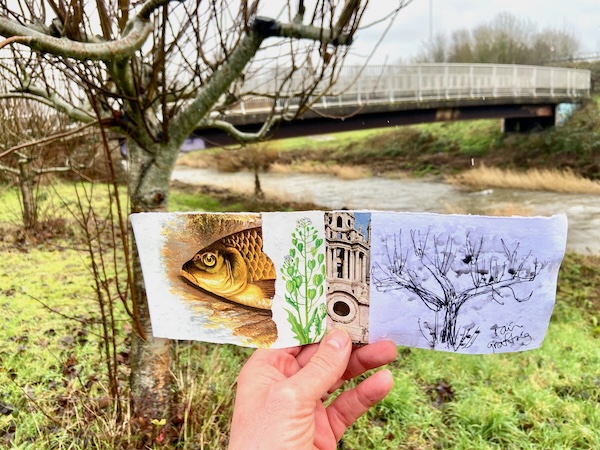
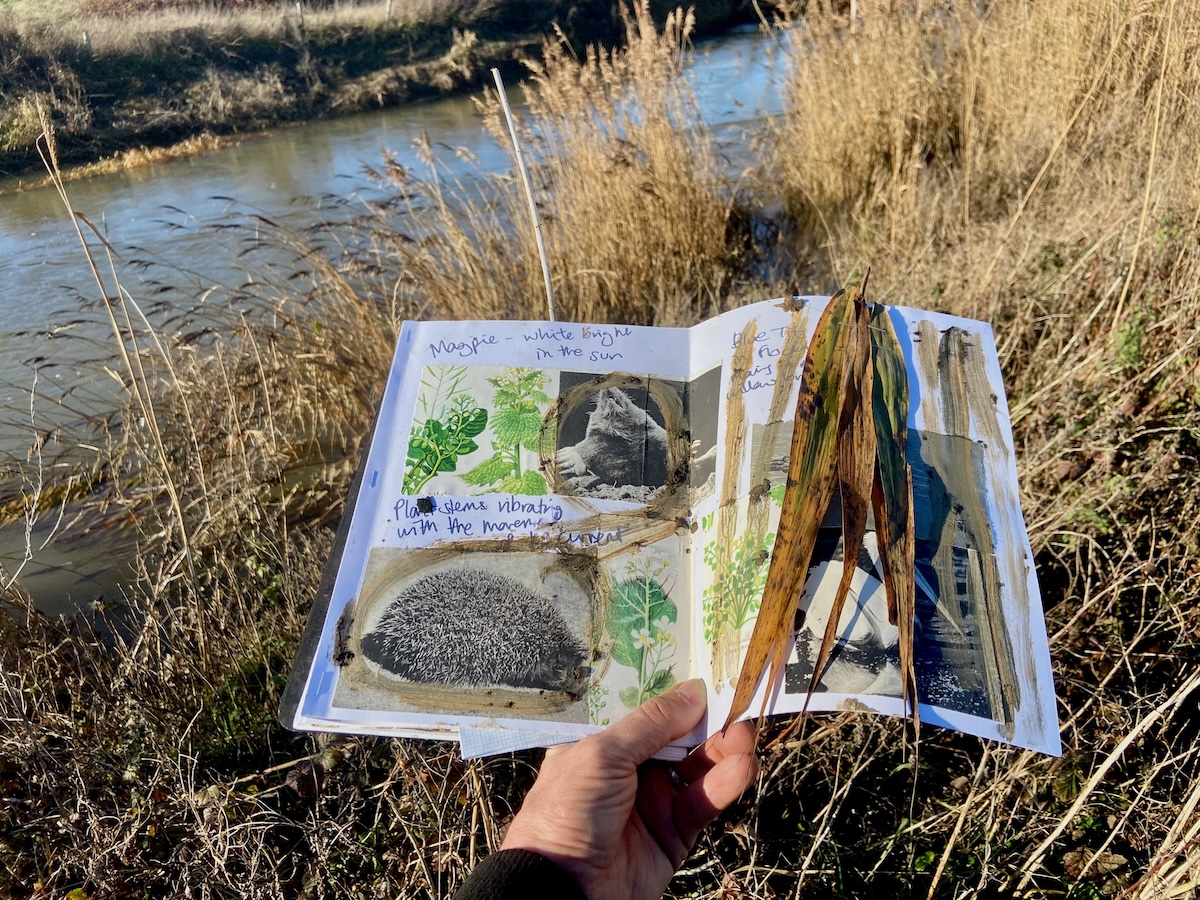
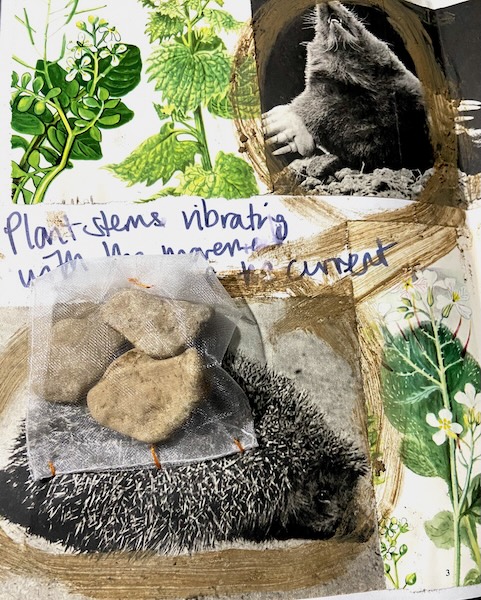
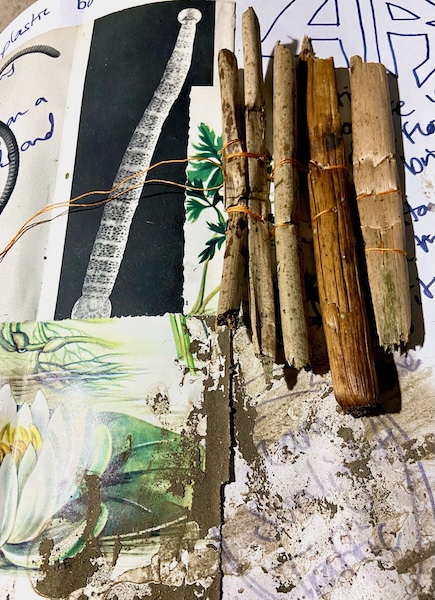
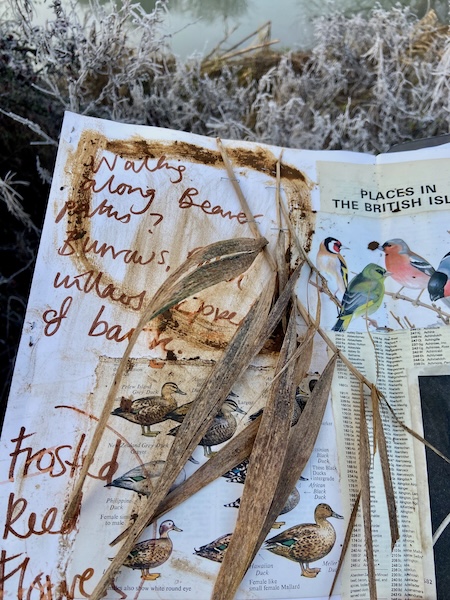
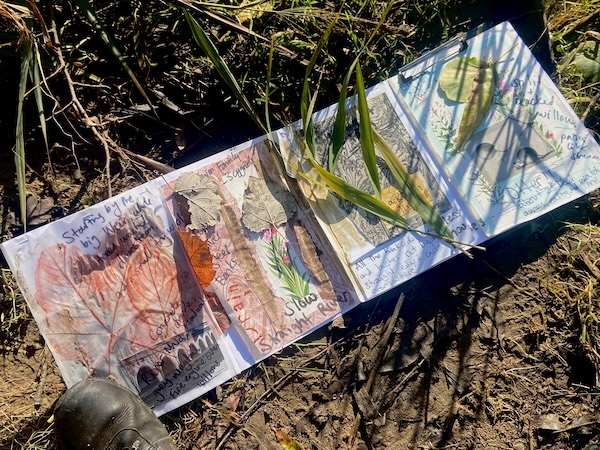
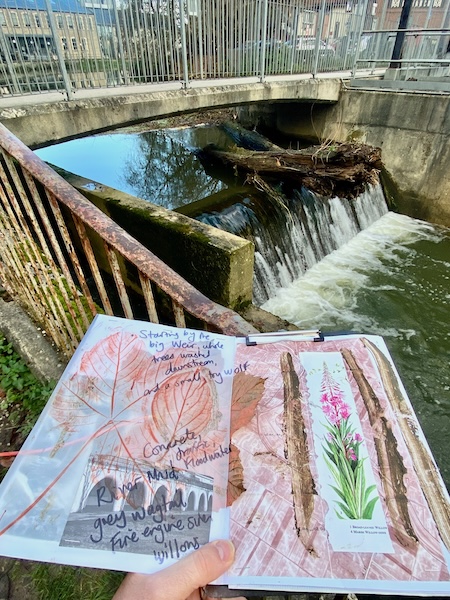
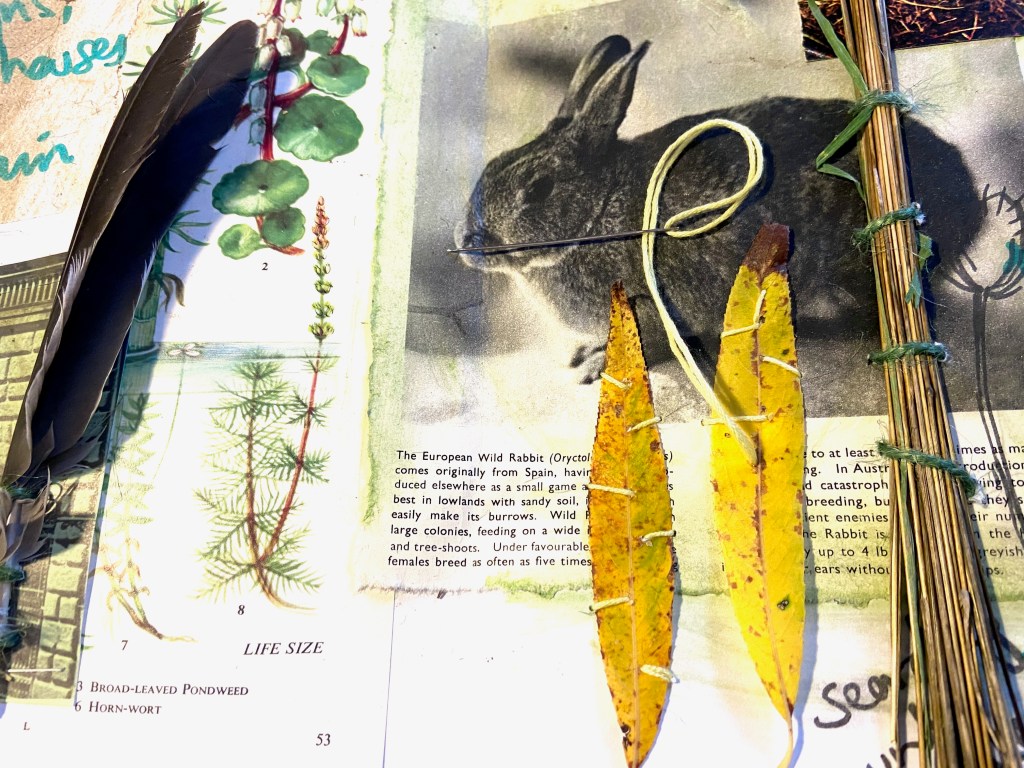
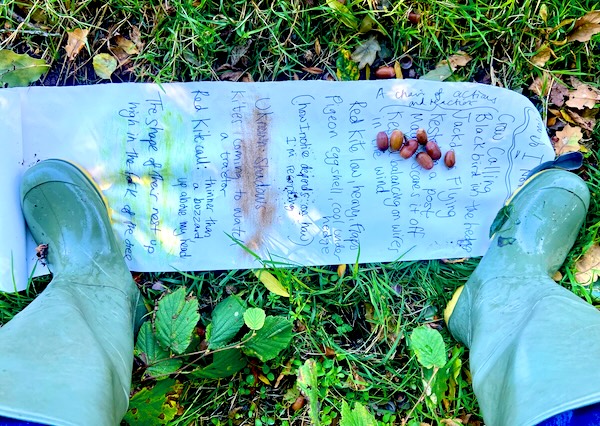
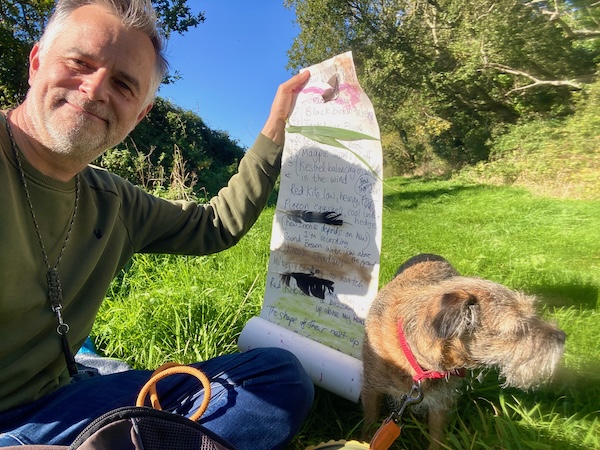
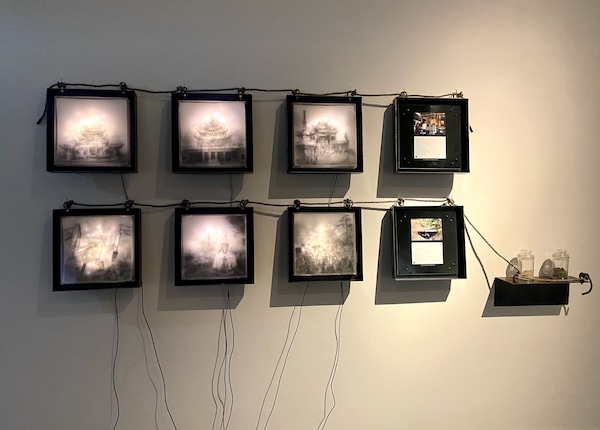
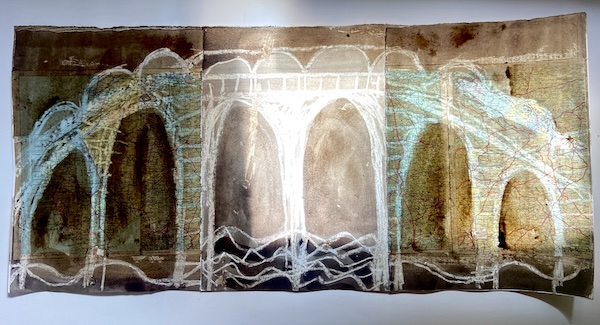
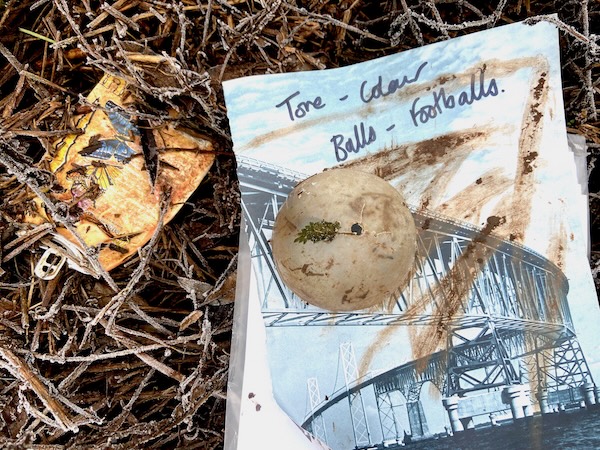
I’ve been using Walking Pages to document and process these walks. My Walking Pages vary, but generally consist of a series of paper pages that connect together in a linear way, recording what I notice as I walk. For these recent walks I’ve been using a fold-out concertina format, made up of six A4 white paper pages overlaid with collected botanical, architectural and other imagery that link to the subject matter of river wildlife and human infrastructure. Onto this surface I write, draw, make rubbings, and attach objects washed up by or left along the river, stapled in the moment or dried out and stitched on later in my home studio.
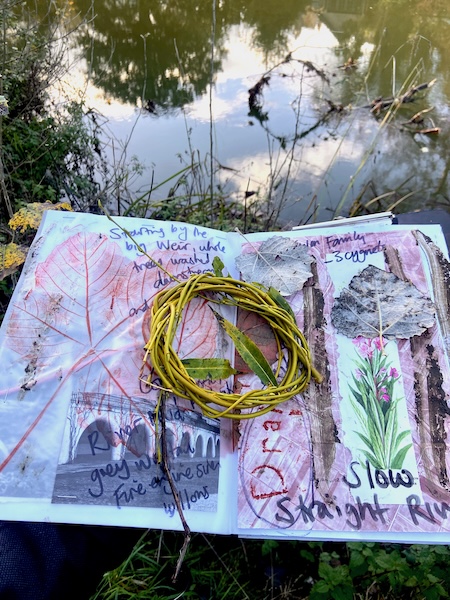
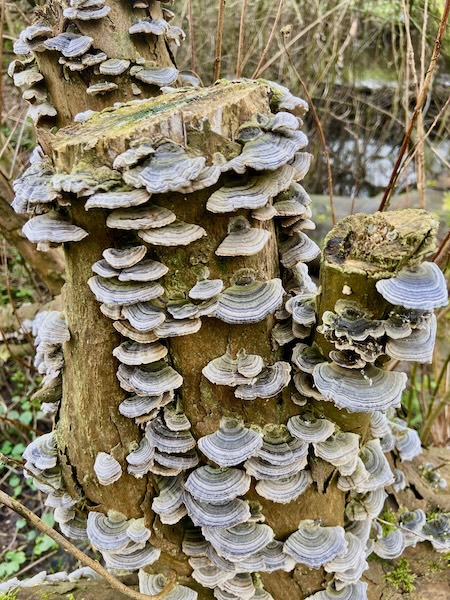
The printed illustrations, representing the idea of the ‘official’ British landscape, blend with the messy, multi-sensory and emotional responses that emerge in the moment, and what the river shows me. This includes a rough list of the mammal/bird species that I see, hear or notice tracks/signs of, and some of the plants too.
‘Noticing is my way of opposing a particular modernist practice of looking towards an imagined future. Certain things get coded as possible futures and then we develop blinders so that all we can see is our trajectory towards one kind of imagined future, which isn’t actually the future but is a stereotyped dream future. And so, we stopped seeing. Noticing is trying to take those blinders off to look at the world around us, with special attention to the more-than-human world, by which I mean the human plus non-human world…’

Anna Tsing, Future Observatory Journal

It’s quite an addictive process. Each walk informs my understanding of the character and health of a section of river, and provides a piece of the puzzle that I am building internally. The more I walk, the better I understand where I live, and that internal model builds. The two rivers connect everything together from chalk downland to railway embankments, agricultural land, towns and nature reserves, bringing life, providing blue/green corridors for the movement of plants and animals, and carrying our waste.

The OS Map App helps me find my way through industrial areas, farms and housing. The coloured dashes that indicate public footpaths and bridleways and which pass most closely to the wiggly blue lines of rivers and streams are the ones that I look for. When I’m a bit lost, a red arrow shows me how to get back on track. Awareness of our local river systems can be so limited and fragmented due to such limited access, so I’m using walking and making to piece together a multisensory, multi-species map using those parts that I can reach, and the Walking Pages are one element of that.

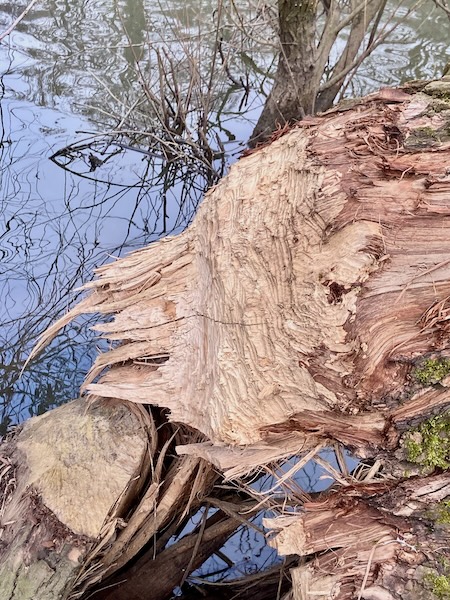
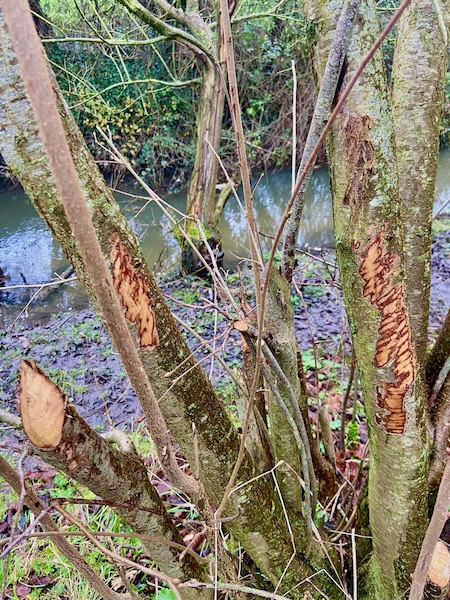
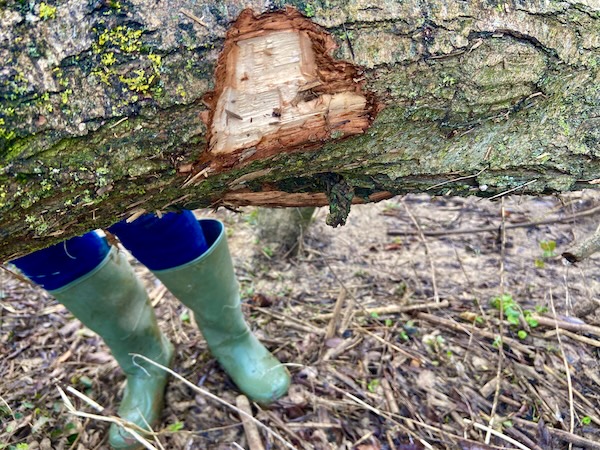
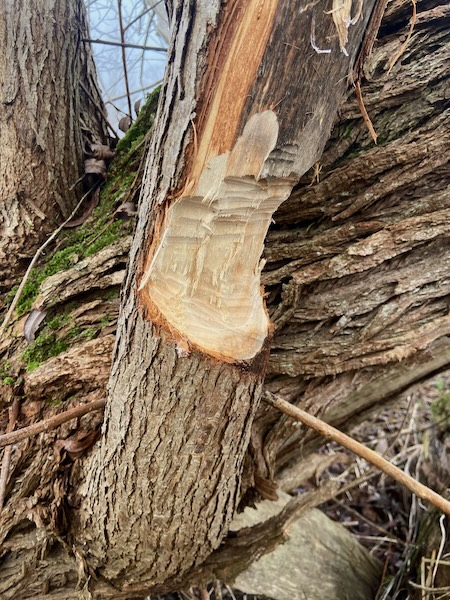
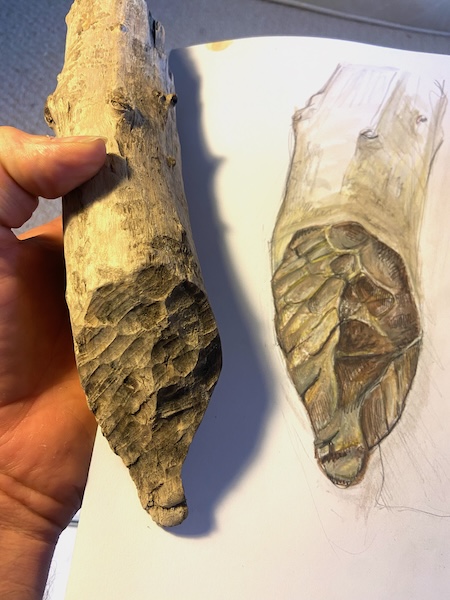
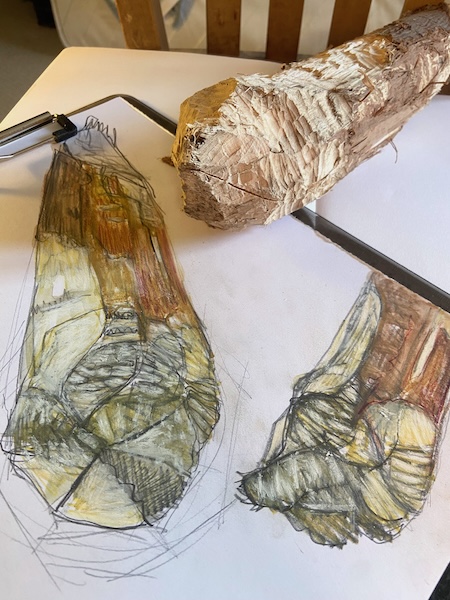
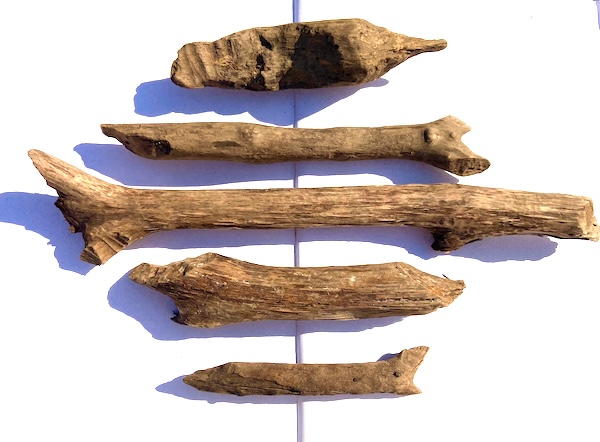
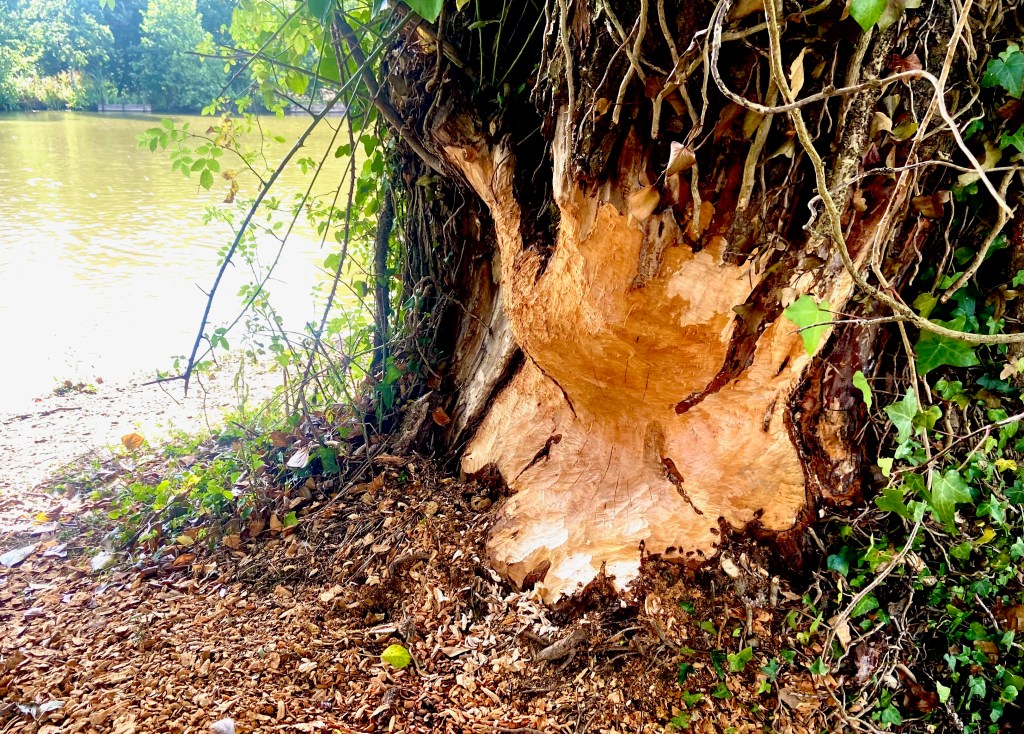
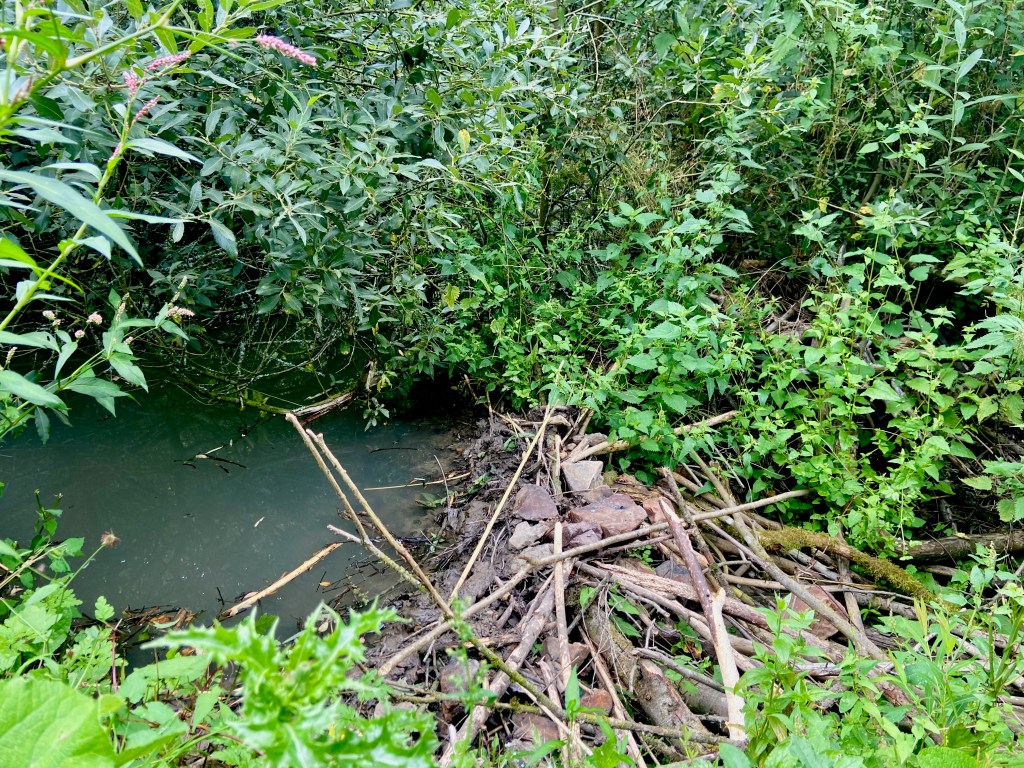
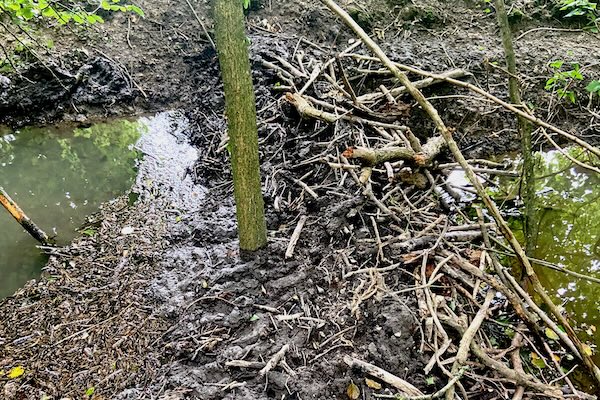
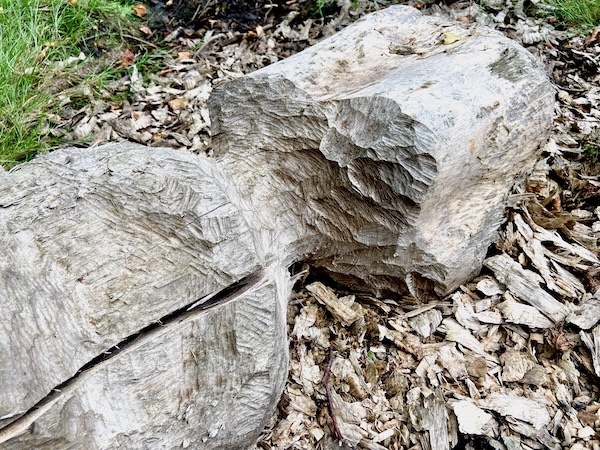
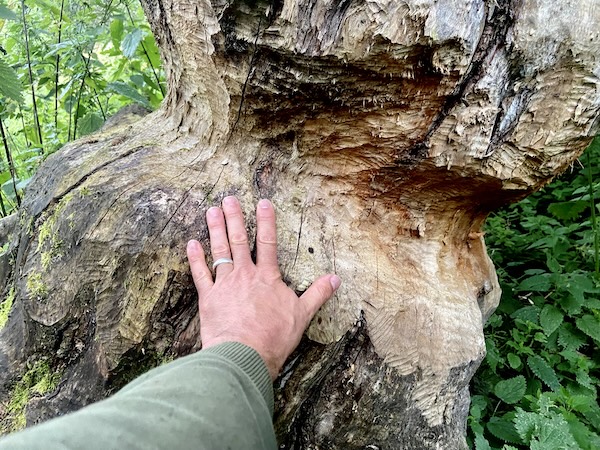
These walks are also helping me to develop my understanding of where beavers are living in Wiltshire, as I research human-beaver relationships, and beavers as makers. I log any signs I find of beavers as I walk, and upload my photographs to the Mammal Mapper App to contribute to county records. I also collect fragments of beaver chewed wood, to draw back in my studio, as a way of looking even more closely, or make scans of them to use later in artwork (video, installation etc).

‘Walking Out’ of town I walk out of a busy mind, out of the expectations of others, the need to mask or perform, and eventually out of the noise and busyness. I find it easier to notice the smaller, quieter details when there’s less people and cars; an otter’s head moving slightly as it chewed its catch near Chippenham for example, a glimpse of pale cream exposed wood amongst darker bark that shows me a beaver has had a chew on a waterside willow branch, or the piping sound of a Kingfisher signaling its arrival, flying low and fast above the water’s surface.

‘I have long thought of the outdoors as an escape, a distraction from everyday life. My safe space. It allows me to unload whatever’s clogging my mind, park it wherever I am, focus on something else… and then return to that original headspace with a clearer outlook. I’m refocusing my attention, yet resting my brain at the same time…’

Joe Harkness, Neurodivergent by Nature

I’m not looking to escape the urban experience all together though, just to bring my full attention to where I am and what I am experiencing. It’s not that a rural area is some kind of green oasis to escape to either, the rural spaces are often as heavily managed and affected by human activity as urban spaces. I can find myself in yellowed, sprayed fields, between chicken sheds or alongside solar farms, or anxiously weaving my way through farm buildings to find a gate or stile thet will get back to the river.

What I am primarily ‘Walking Out’ of then, are inherited ideas of the urban and rural, of what a river is and who lives there. What I’m ‘Walking Towards’ are direct experiences of the reality of that place, received through my body and my senses, and processed through making. The making of this kind of artwork acts as a mechanism for noticing and recording (in a similar way to my Walking Bundles). I do it to understand rivers as communities of life that weave the urban and rural together, experiencing which animals and plants live where, and the impact that different kinds of land-use have on the ability of a river community to live, grow and flow.

The return of Beavers to Wiltshire has provided me with a new way to think about and with rivers when I’m walking. Is there potential in that section of river for a family of beavers to re-make it to meet their needs? Can they create the space and habitat for the other species that their re-making supports, or is the river too constrained by farming, roads etc? And what happens when human and beaver infrastructure combine or collide?

‘Across Britain, rivers and streams have been heavily modified, with 85% of our rivers straightened, confined, or cut off from their floodplains. These changes have limited the ability of rivers to function naturally, contributing to increased flood and drought risk, declining water quality and the loss of biodiversity.’

Beaver Trust – Making Space for Water

We might expect these kinds of issues to be discussed by ecologists, environmental scientists, geographers, or maybe urban planners. Similarly if you mention environmental education, most people would think of science communication.

For too long art has been the ‘nice if you have time for it’ subject. Something decorative, something to make you feel good in your spare time. But arts practices developed in dialogue with places and communities, can provide us with sensitive ways to notice the reality of, and build new kinds of relationships with, the other beings with whom we share such places. Relationships vital to our ability to live well in a future impacted by climate breakdown.

I’ve been fascinated by and felt happiest alongside other animals since I was a small child. When I was growing up I had drawers full of shells, feathers, skulls and bones. I kept a folder on the wildlife that I had found in our garden. My favourite book as a small child was an Encyclopaedia of Animal Life, until I graduated on to The Amateur Naturalist by Gerald and Lee Durreell which helped me plan ant farms or owl pellet dissections. I kept injured birds and animals in the back garden or spare room and was always going to work with animals when I was older.

But the Secondary School career options, that offered an art or science route from school into University, couldn’t accommodate me and my creative, neurodivergent mind. So my planned Zoology degree turned into Fine Art instead, with as much time as I could spent outside the studio, in the woods and by the river, and a career of almost 30 years since, spent developing participatory methods to engage communities with their local natural and cultural heritage.

My arts practice now recognises and models the value of fusing art and science, and as a kind of hybrid Artist/Naturalist I provide ways of knowing places and ecosystems that use art and walking to go beyond the restrictive binaries and boundaries that divide art/science, urban/rural and human/nature, and blinker us to what else might be possible.

Bringing art and artists into dialogue with those working within river restoration, rewilding and other regenerative land practices, has the potential to support the development of new ways of knowing and being with wetlands, through creative mapping techniques and community engagement. Art practices can also be devised to include and learn from non-human animals (hence my beaver research), as practiced by many indigenous societies.

It may have taken me a while to see it, but looking back my career path created a role for myself that didn’t at first exist. My working processes as a practicing artist, and the sensitivity of my Neuroqueer body-mind allow me access to a complex, multi-faceted understanding of what we have come to call Nature, and our place within it, developed through direct experience, creative dialogue and collaboration, where sensory and cultural differences are valued for the insights that they can offer us all.

And I get to learn from beavers…

How do I notice birds?

I’ve had a very rich and busy September. Working with groups and individuals in Liverpool with Up Projects, in Somerset with Hauser and Wirth and Spike Island, in Bath with Forest of Imagination, some really rich time in Portsmouth, beginning a ‘walking and talking’ mentoring process with artist Hannah Mae Buckingham. I’ve also started an exciting new advisory role with Not Bourne Yesterday: Chalk Stream Communities of the Chilterns (more to come on that soon).

Right now it’s time to slow down a little and settle into my home patch again, letting everything from these last few weeks settle, and decide where I’m heading next, in terms of focus/subject matter/media.

A couple of days ago on social media I came across an American 11 year old boy called Samuel Henderson, who can do amazing bird impressions (impressions doesn’t seem the right word somehow, he embodies them through sound), and is also autistic. I was blown away by his skills, and set thinking by an instagram post that said what an amazing hunter he would have been 150 years ago. Why a hunter? What other benefits come from inter-species communication? What about the wider value of learning from and connecting with our non-human kin?

As well as connecting with my Neuroqueer Ecologies research, he made me think of Irish sound recordist and ornithologist Sean Ronayne, who went on a mission to record all of the native birds of Ireland, and who is also autistic. There’s an interview with Sean here where he talks about the relationship between sound sensitivity and autism, and a starling that learned to mimic his voice and Cork accent, amongst other things.

‘…I’m seventy, up to ninety percent tuned into the frequency of the natural world, my ears are scanning. And when I’m having a conversation… my attention is only partially yours. If anything else speaks up, a bird or whatever, I’m gone.’

Sean Ronayne

When I first set up Queer River I was thinking about what queerness brings to an awareness of ecosystems, and since then have brought neuroqueer experiences into the mix too. When first exploring LGBTQAI+ people’s experiences of green and blue spaces, I was partly looking at the impact that trauma plays. For instance, one article (the reference is lost from my memory sadly) mentioned the possibility that the hyper-vigilance that a queer person might experience in certain settings, due to traumatic previous experiences or a more general awareness of the risk of being openly queer, could also lend itself to a hyper-awareness of birdsong.

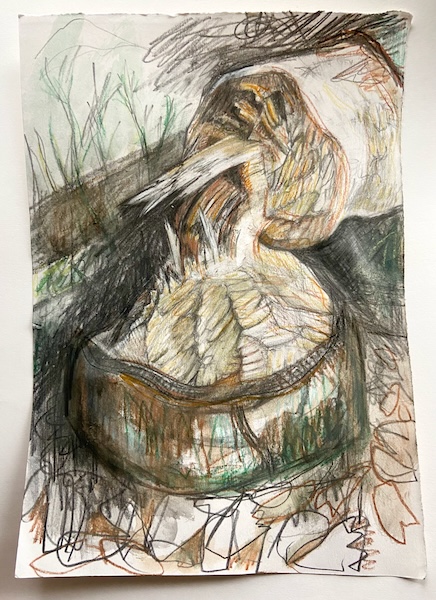
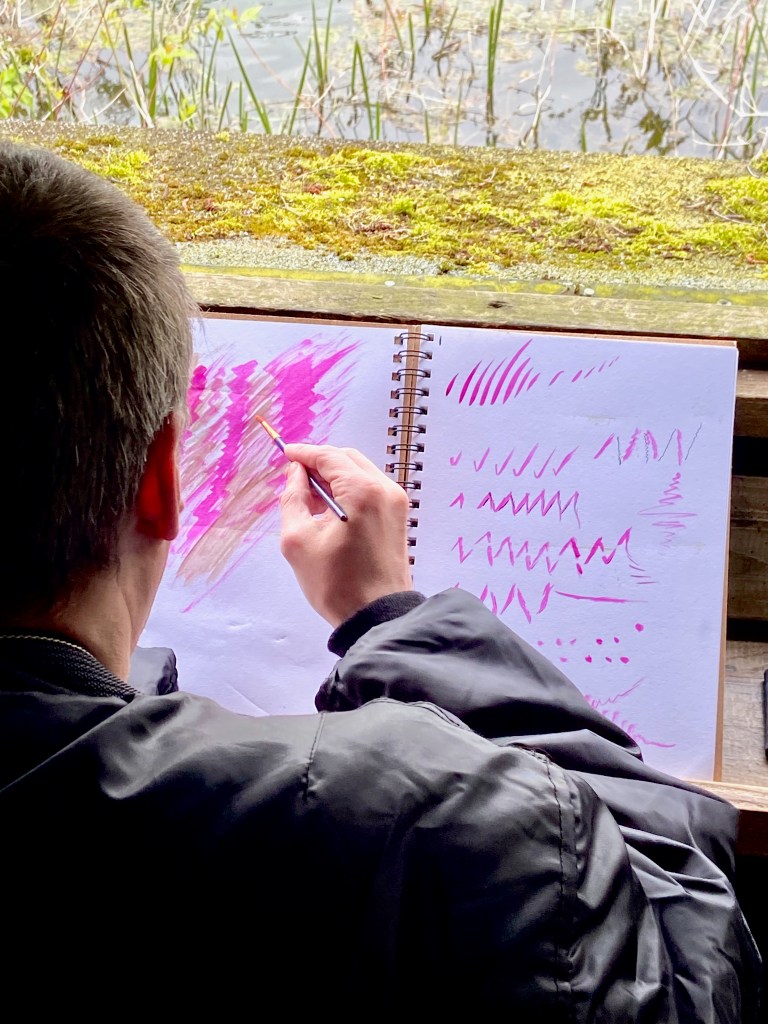
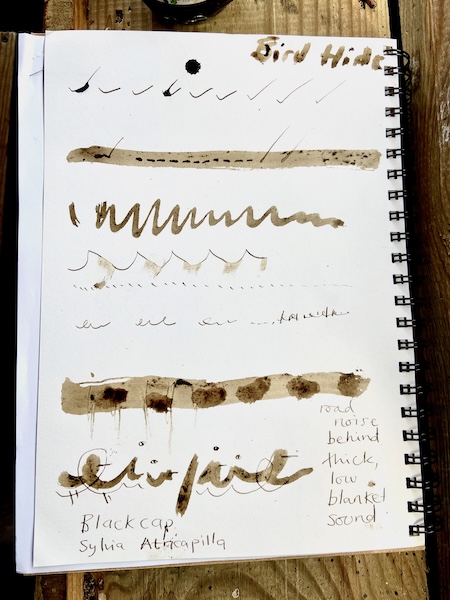
In previous work with organisations (e.g. a project/course for Well City Salisbury (WCS) and Wiltshire Wildlife Trust, images below) I have supported participants to use visual ways to document their experiences of birdsong, partly inspired by spectrograms. I also produced an activity resource on a similar theme for WCS. Over the years I’ve researched Great Bustard reintroduction, the place of Swans in popular culture, and the work of artists and composers (e.g. Marcus Coates and Stevie Wishart) that have been inspired by and collaborated with birds.

What I’m interested in now, is the relationship between autism (and neurodivergence more generally) and birds/birdsong. As well as Samuel and Sean, well known autistic naturalists such as Chris Packham and Dara McAnulty, (author of Diary of a Young Naturalist), are also drawn to birds. Do we all share something? What relationship do sensory and processing differences have with a sensitivity towards/appreciation of birdsong?

‘I was studying badgers and kestrels… my life was pretty polarised between punk rock and birds. I became very solitary… I was very confused and angry, principally with myself, because I didn’t understand why I was different from other people and I couldn’t see that difference. To ourselves, we all feel normal. At that point, I was trying not to communicate with anyone. My mission was to get my degree, do a PhD and spend the rest of my life hiding in an ivory tower studying birds…’

My Younger Self Would be My Biggest Critic, Chris Packham

Joe Harkness has recently released the book ‘Neurodivergent by Nature, published by Bloomsbury. Joe’s book is a follow up to his first book Bird Therapy, which drew from ‘...his personal experiences with mental health challenges, Joe discovered solace and resilience in the natural world, particularly through bird watching.’ Joe and I were going to meet as part of his research for the new book but that didn’t quite happen in time. I’ll be reading it soon though.

‘After receiving an ADHD diagnosis in his thirties, Joe Harkness began to question whether his bond with nature was intrinsic to his neurodivergence or something developed through his life choices. Keen to know more, he connected with other neurodivergent people who share his passion for the natural world. Threading their stories with his own, Joe explores why they chose to seek diagnosis, the ways they find solace and understanding through nature, and what led many of them into nature-related careers.’

Exploring the connections between nature and neurodiversity, Bloomsbury

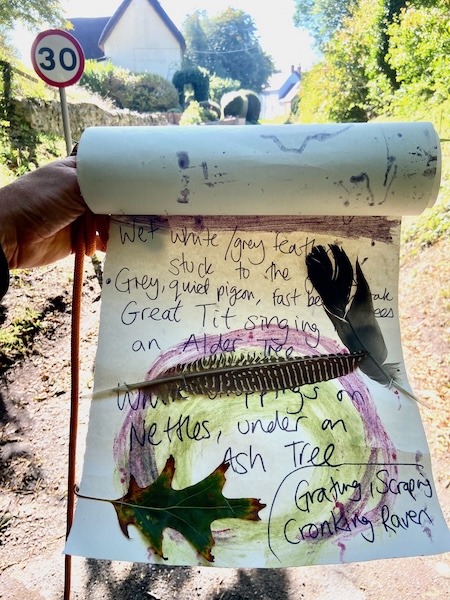
As usual, my initial research uncovered more questions than answers, and with an already slightly overloaded brain after a busy few weeks, I decided to get out of my head and out of the house. So I went on a walk, with a long blank roll of paper, a black pen and a stapler. As I asked a question of the children that I collaborated with at Forest of Imagination in Bath – ‘Where does a river begin?’ – so I asked myself a question on this walk – ‘How do I notice birds?’ – trying to become more conscious of how I become aware of birds, and the role that my different senses play.

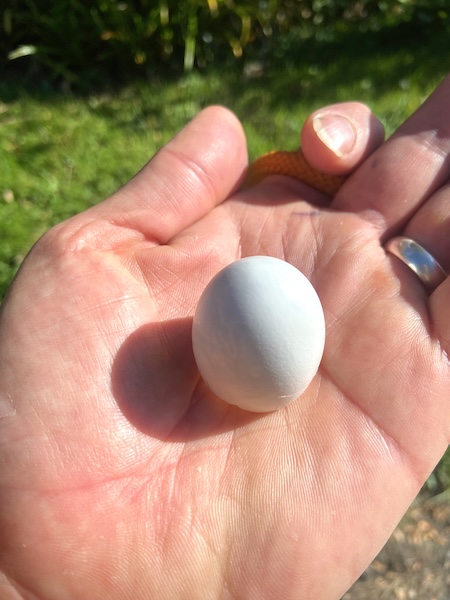
As I walked out of my house and on a loop that took in the River Avon, country lanes and sheep fields, I wrote down each bird I noticed and how/where I’d noticed it. Seeing a Kestrel perched on a telegraph pole, hearing the calls of a family of Red Kites that nest nearby, seeing/feeling the shadows of unknown birds passing over the tarmac in front of me, picking up a grey, loosely banded Woodpigeon feather.

I noticed chains of reaction as a Kestrel spooked a group of Jackdaws that flew across the sky, flushing a Magpie which then rose up out of the hedge, pushing the by now perching Kestrel off of its perch, up to where my eyes connected with a Red Kite in the distance, coming to see what food a tractor cutting silage had exposed.

As I walked, I thought about how in the moulting season I had gathered quite a few feathers from birds of prey, and that had became the most noticeable bird presence. If I’m collecting objects then I’m more likely to notice feathers, whereas if I’m filming or have my sound recorder with me then I pay more attention to closer, bigger, more ‘filmable’ birds such as swans, or bird song and sounds. When I was in the New Forest looking for evidence of the animals that lived there as part of my Neuro/Queering Nature residency with Spud, I was paying more attention to footprints, and whoever had recorded themselves on my camera trap.

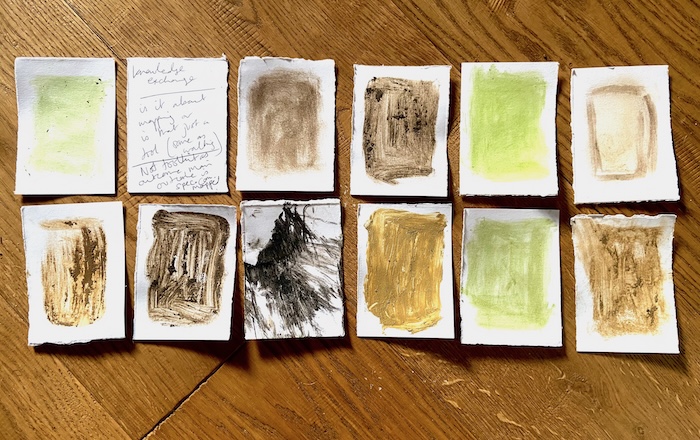
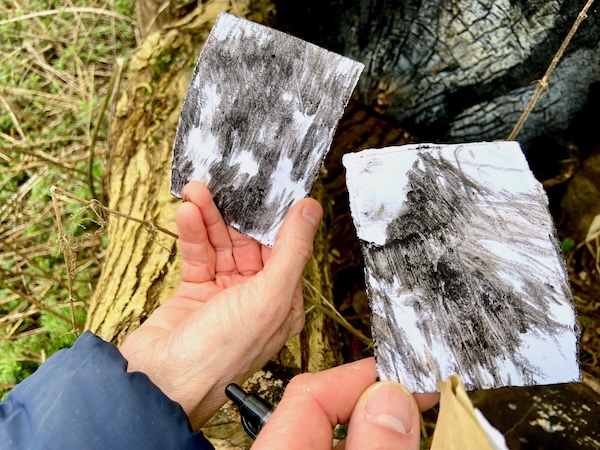
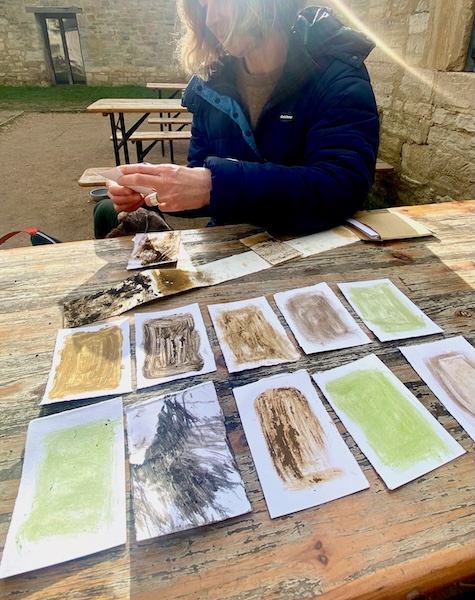
Ultimately though, in my arts practice I tend to draw on all my senses and piece together a more holistic ‘picture’ of my environment through their interconnection. I’m less likely to prioritise one sense than another. Walking and telling myself to only notice birds was hard, it started to make me feel tight and tense, which wasn’t the idea of going for a walk at all. The huge amounts of shiny acorns on the floor, the changing colours of the leaves, sheep wool on the fence, all called for my attention. In the end I cut myself some slack and started adding a little colour between the rows, smearing the last of the year’s blackberries, rubbing on fresh green grass and some mud exposed by the scraping of deer hooves. For me the birds don’t exist in isolation, everything is interwoven.

The usual benefit to me of going on a walk, especially after a busy time of designing and holding spaces for others, is surrendering to the place and what it wants to show me. It’s a chance to let go of the need to focus my attention and meet others’ expectations, and to allow my boundaries to dissolve. Trying to only notice birds didn’t quite fit with that, even though it was my own agenda.

‘I think there are multiple effects that nature has on me. First of all, it gives me a place that has no judgement in it; a robin is not going to turn around and tell me, ‘What you’re doing is stupid’. And that sort of freedom in a place where I can just go, and I know that there’s going to be no backlash from it, that I can just relax, and from that it gives me a sort of base grounding point from which I hold an anchor myself in my life.

Every time I go out into the forest, I gain almost new layers and old ones are taken away as I go over falls. And this I think is one of the most important things that I found in nature, that when you’re in it you can sort of go into your thought processes in your mind, and pick the problems and the areas that are going wrong and fix them. And there are no distractions that you find from the real world, that will divert you from this course. It’s just you, nature, and your own mind…’

In Conversation with Dara McAnulty, Dara McAnulty

One of the reasons I didn’t originally think that I could be autistic was that I didn’t fit the usual idea of what being autistic looks like, and I am intrigued by the fact that I still don’t feel like I fit. My noticing of birds isn’t like Samuel’s or Sean’s. But my need to get outside and be with non-human animals is. The benefits sound very similar. So perhaps what we share is the need to decompress after consciously editing and masking ourselves to navigate social spaces, and the sensory sensitivity, and hyper-empathy, that enhances our awareness of other animals and our entangled relationships with them.

Research shows that many autistic people have experienced trauma, from bullying, harassment or abuse, or from the constant grind of trying to navigate social systems that don’t cater for our needs. All of the people I’ve mentioned above have described the therapeutic value of time spent ‘in nature’ (in a less human dominated world, where other voices can be heard).

”Belonging’ conveys the experience of becoming whole through integration of all aspects of ourselves, including the shadow aspects we conventionally suppress. Time with the wild non-human world can support us to do this, as we re-experience ourselves as part of our entangled universe. This can be particularly true for autistic people. Time away from humans provides the rare possibility of being able to fully unmask, allowing complete sensory immersion and self-integration.’

Belonging (March 2023), Kristen Lindop (image above)

We are different to each other, as all autistic people are different, but we all benefit from time spent outdoors, outside of busy urban environments, opened up to the communication of the more than human world. Aided by our sensory sensitivities, that in other environments can cause distress and discomfort.

But why birds in particular? I don’t know about that yet, but I’m aware that the majority of examples I’ve used above are white, male-presenting people (apart from Artist Kristen Lindop), and that birdwatching and the spaces associated with it can be very white, male spaces. The practices of keeping a bird list in birdwatching also echoes the urge to collect that I mentioned above, that some autistic people experience. With Sean there also seems to be something about collecting the calls of all Irish native birds (see my earlier post on autism and collecting here).

I only recognised myself as autistic when I started to look at and hear from a wider range of autistic experiences, particularly women and gender non-conforming people, and I’d be keen to hear from women, trans/non-binary and Black neurodivergent people on their experiences of birds/birdsong and birdwatching.

‘I experience strong physical and emotional responses to many presences, particularly birdlife… Being with, and becoming with, birdlife is a powerful multilayered experience for me – in my art practice and in my life in general’

Artist Kristen Lindop (via instagram)

Please do comment or email if you have thoughts or experiences that you’d be happy to share. In the meantime I’ll leave you with a short video clip of a hunting Kestrel from near the end of my walk…


NB. I’m aware of scientific research carried out comparing bird and human brains, deliberately impairing the ability of birds (e.g. captive Zebra Finches) to sing, in an attempt to understand what might cause some autistic people to be non-speaking. I have chosen not to go into that in depth here.

A Taste of the Mersey: Racial Justice and Regeneration

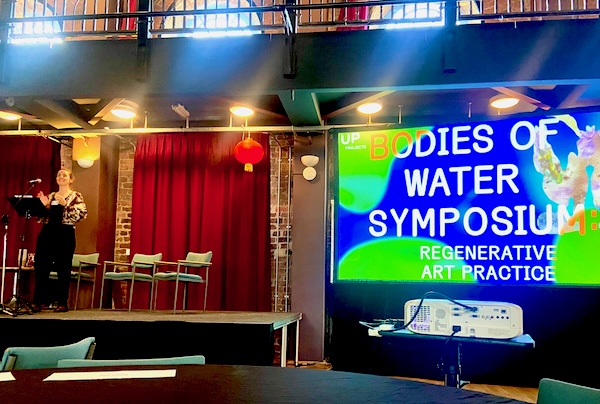
On Thursday I led a walk in Liverpool titled Neuroqueer Ecologies: Noticing Differently, as part of the UP Projects symposium Bodies of Water: Regenerative Art Practice. The symposium was curated by Justine Boussard (below, left) and partnered with the Liverpool Biennial, with an associated public art commission by Anne Duk Hee Jordan at A la Ronde in Exmouth and Haigh Hall in Wigan.

Before I left Liverpool on Friday I also managed to get around a few of the Biennial venues, visiting work by artists that connect with my practice, curated this year by Marie-Anne McQuay.

It’s only the third time I’ve been to Liverpool, and the last time was about 30 years ago, so I write this as a visitor, sharing a sample of what most connected with me and will feed into my Queer River research.

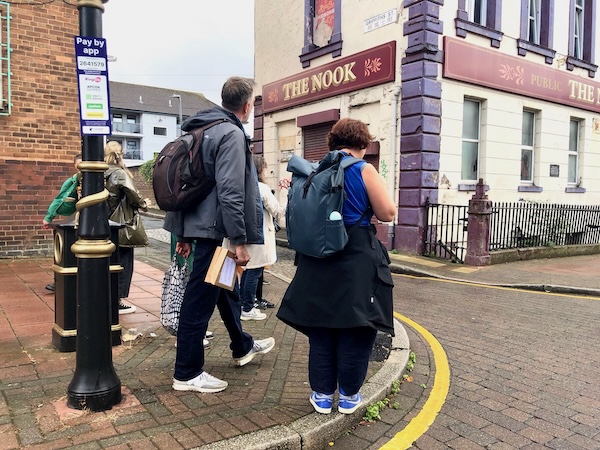
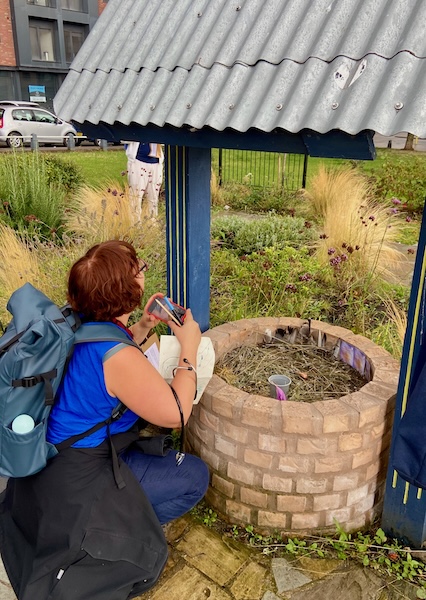
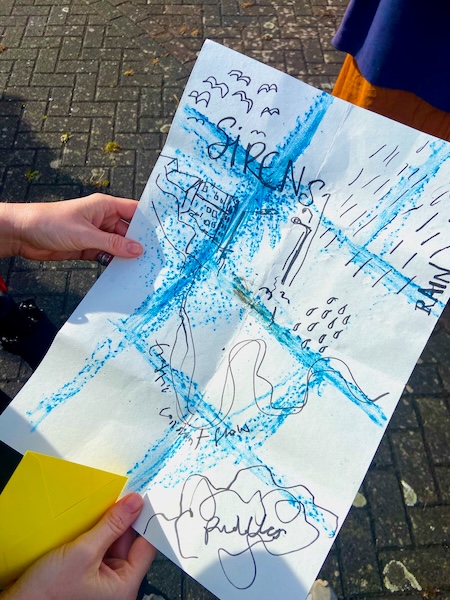
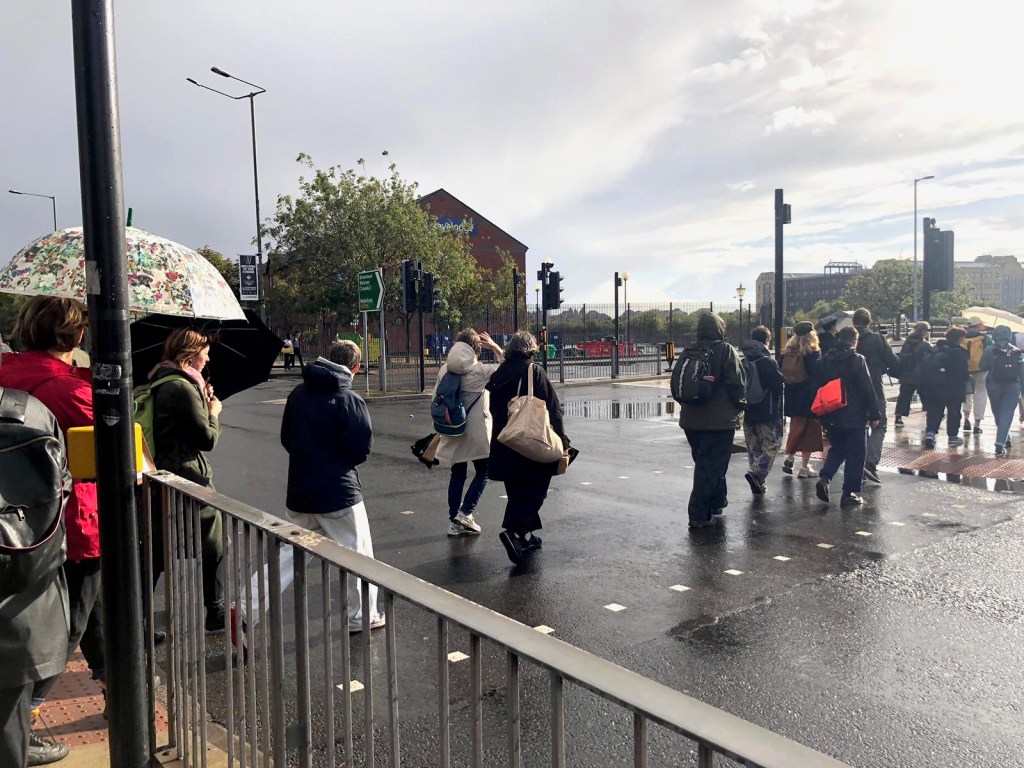
My walk aimed to offer a taste of the methodology that I most use within Queer River – walking, talking and making with rivers; noticing how water moves/is moved through the city, and following it down towards the docks. I wanted to highlight the insights that neurodivergent perspectives on ecosystems can offer, and bring the subject of watery, regenerative practice into a real world setting, through an embodied experience.

At the start of the walk I shared the following quote from autistic Philosopher Robert Chapman:

‘A radical politics of neurodivergent conservation is also consistent with a radical politics of environmental conservation. After all, it has been the same logics, the same system, that has ravaged the biodiversity of the planet as has sought to eliminate the neurological diversity of humanity…’ 

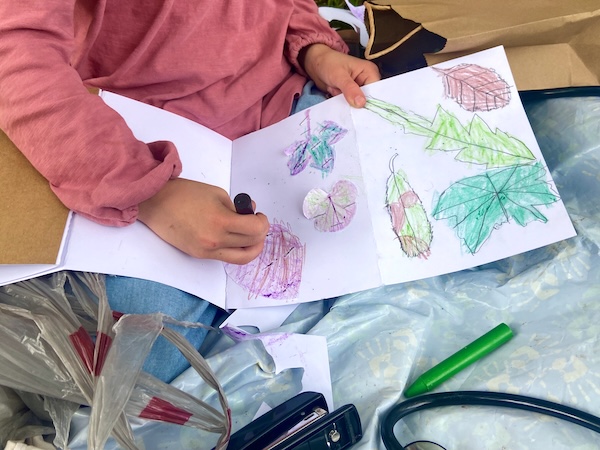
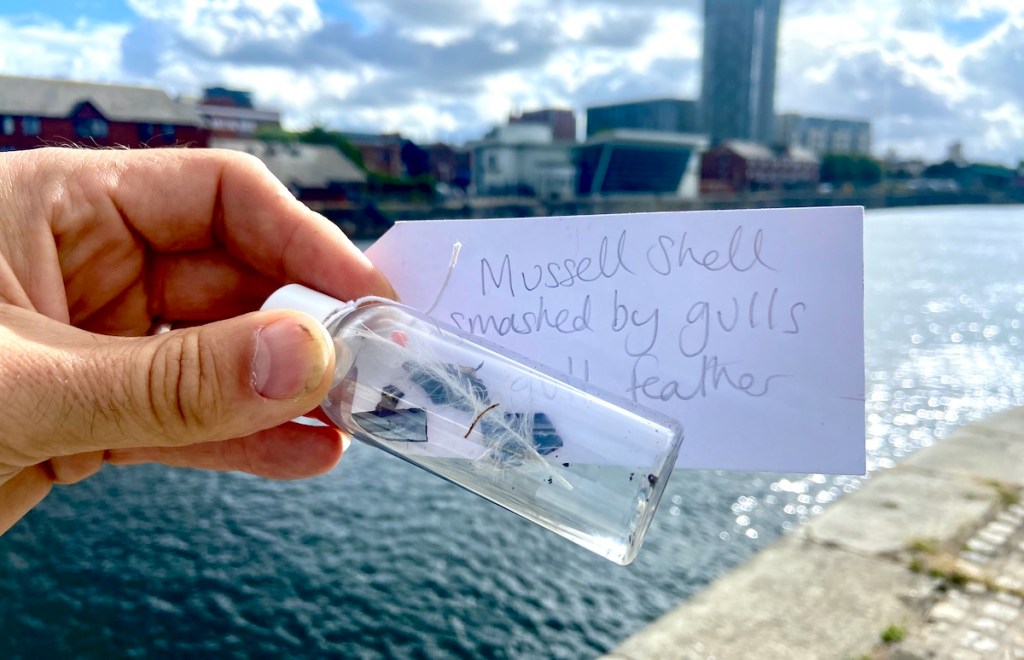
I gave each person a pack of resources to document what they noticed (a blank paper map, pencil, crayon, empty bottle, envelope), and I carried another bag of equipment (stethoscopes, magnifying glasses etc) for us to share.

Before going to Liverpool I had started to look into the history of the River Mersey and its place within the city’s culture. It was almost exactly 4 years to the day that I had arrived in Glasgow for Queer River Wet Land. There I was working with the University ahead of Cop26, to reflect on and walk with the Kelvin and the Clyde, learning about their industrial heritage and potential future flooding, and thinking with others about whose voices are heard in discussions on climate breakdown and river futures, and whose voices are missing. Similar thoughts were going through my mind about The Mersey.

I first discovered that the Mersey is thought to take its name from its place as a boundary between Mercia and Northumberland (and more recently between Lancashire and Cheshire), but that possible earlier Celtic origins link the modern name of Mersey with Meteia, meaning ‘the reaping one’ or ‘she that cuts down.’

Also, I was aware of the role of slavery within Liverpool’s history as a port city, although less familiar with that history than with towns and cities nearer to my home in Wiltshire (see an earlier post here).

Liverpool ships were responsible for the transportation of over 1.1 million enslaved African people to the Americas between 1750 and 1807, more than any other British port. Written histories of the town begin to appear in the midst of Liverpool’s rise to prominence in the ‘African trade’, at the end of the eighteenth century. Liverpool reached its slave-trading apogee during the decade of legal abolition at the very beginning of the nineteenth century, when the town owned close to 80 per cent of Britain’s total slave trade.

Liverpool’s local tints: drowning memory and
“maritimizing” slavery in a seaport city

As a white person, and a Dad to a teenage boy of Jamaican heritage, I’m keen to advance my learning on the place of slavery within British history, and of racial justice within environmental/climate issues. My knowledge of climate justice draws on the experiences of different communities, including recent work with Disability Arts Online, on behalf of Climate Museum UK, to providing professional development on the relationship between disability justice and climate justice.

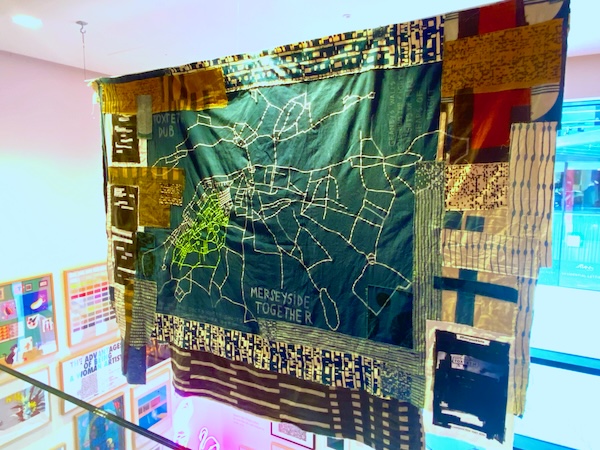
One of the things that stood out whilst digging around online, was a quote from a speech by Michael Heseltine in 1981, written whilst staying in the Atlantic Hotel, and ‘standing with a glass of wine’ overlooking the Mersey. Heseltine was in Liverpool following The Uprising of Liverpool 8 (aka the Toxteth Riots):

“The Mersey got to me. It was enormously significant in the history of our country, and I felt a debt to that river…It was an open sewer, and I felt deeply sad that we hadn’t realised what an enormous, valuable resource it was. That was where the idea came from, that we must make good the degradation of centuries.”

Heseltine’s ‘It Took a Riot’ speech led to the development of the Mersey Basin Campaign: ‘established in 1985, with government backing and a 25 year lifespan, to address the problems of water quality and associated landward dereliction on the Mersey and its tributaries..’. The MBC worked with local people to improve water quality and encourage ‘sustainable waterside regeneration’. Their work is now continued by the Mersey Rivers Trust.

The cleaning up of the Mersey was obviously a very good thing. In 2002 oxygen levels were reported as being able to support fish along the entire length of the river for the first time in recent history, after years of pollution by sewage and industry. Salmon returned, and occasional grey seals, porpoises and dolphins visited (sadly today the Mersey has one of the highest loads of ‘forever chemicals in the world). A Conservative minister being praised as the saviour of the Mersey however, at a time when poor housing, environmental pollution, high unemployment and institutional racism within the police, had led to the disturbances that brought him to Liverpool, seems pretty simplistic.

‘Heseltine’s correspondence itself indicates that the release of details of the new arrangements for Liverpool’s regeneration should not be released until he had returned from holiday, stressing that ‘he does not want the statement to go out while he is lying on a beach in Mauritius. He thinks the reaction would be unfavourable’.

Disorderly cities and the policy-making field: The 1981 English riots and the management of urban decline.

The Thatcher government’s economic and social policies played a key role in the decline of British industries and communities in the 1980s and 1990s, just as austerity and Brexit have in recent years, and Douglas Howe then Chancellor of the Exchequer, was quoted as suggesting a ‘managed decline’ of the city. The uprisings in Liverpool and in Brixton (and several other major cities) led to the commissioning of the Scarman Report, which highlighted the need for policing reform and improvements in housing, and identified ‘racial disadvantage’ as a key factor in the disturbances. The Scarman Report also informed the development of the Race Relations Act in 2000.

A Liverpool University survey undertaken 5 years before the Toxteth riots revealed that 31% of local employers admitted to acting in a discriminatory way to black applicants…’

The approach taken to regeneration in the Toxteth area included compulsory purchase and demolition of housing (including social housing), with associated impacts on local communities. A campaign was eventually set up to save the ‘Last 4 Streets’, leading to the creation of Granby 4 Streets LCT in 2011, who went on with Assemble to win The Turner Prize in 2015:

‘After the riots in 1981, the streets of Toxteth in inner-city Liverpool went into decline and its housing, services and residents suffered with it. The situation was compounded by a series of failed regeneration plans, leaving the streets drained of life. After 30 years of neglect, the local community decided to take action; they started cleaning, planting and painting their streets and over 100 boarded up terraced houses in them. They set up a vibrant monthly market and they campaigned to stop the demolition of the last four remaining original streets.’

Granby 4 Streets, Ideas Alliance

As we walked from Black-E on Thursday (our base for the symposium), down to Queen’s Dock, all of this was in the back of my mind; the relationship between regenerative practice in public art, the restoration of wetland ecosystems, and the regeneration of post industrial/urban areas, where economics, politics and racial justice all come into play.

The creation of the city of Liverpool involved building over large sections of the Mersey watershed and its associated ecosystems, as well as creating a hard edge along the main Mersey channel. Building over what originally would have been a network of smaller waterways, and creating large areas of hard surfacing, both increases flood risk, and denies space for plants and other animals to live.

‘Liverpool is the forth highest risk in the country for surface water flooding. This is a result of urbanisation, aging infrastructure and that a large percentage of water courses are culverted which leads to standing water.  Because of climate change, both the chance and consequence of flooding has increased.’

Merseyside Prepared

On our walk we noticed mosses and Buddleia sprouting from older brick buildings, and a small artificial island in the Wapping Dock that had provided a place for a family of Canade Geese to nest. Buddleia often appears in urban areas, sprouting out of cracks in walls and pavements. The botanist Mark Spencer, with whom I walked for Queer River in 2021, described how Buddleia is planted to attract butterflies, and readily spreads along connecting structures such as roads, railways and rivers, but that no studies had been carried out on its impact on butterflies. They readily feed on its nectar, but its leaves don’t offer food to caterpillars, and it may actually out-compete those plants that do.

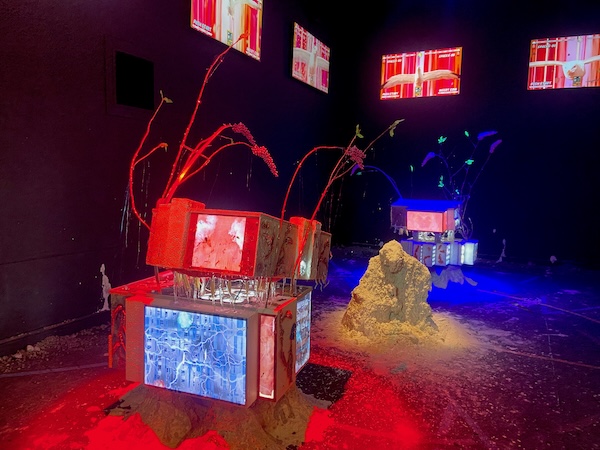
I was excited to see that Liverpool Biennial artist Kara Chin had included modelled mutant Buddleia plants within her installation Mapping the Wasteland: PAY AND DISAPLAY (above right) at FACT Liverpool this year. The text alongside reads ‘The Buddleia plant was first brought to the UK from China in the 1890s…Chin draws comparisons between Buddleia’s status as an ‘invasive’ species and the racist language used in mainstream media about immigrant populations’.

My recent work with young people at the John Hansard Gallery in Southampton, another port city, responded to the work of Palestinian Artist Alaa Abu Asad who similarly explores cultural responses to the spread of invasive Japanese Knotweed, as a metaphor for racist and xenophobic language used in relationship to human migration.

My own research has started to look at whether reintroduced native wetland species such as beavers can be said to bring an indigenous perspective to river restoration (re-making) in the UK, and what multi-species collaborations can offer us. What could I as an artist learn from being apprenticed to beavers?

The morning after the symposium I continued exploring the waterside, via a walk to Open Eye Gallery and Tate Liverpool, to meet the artist Helen Kilbride. As I wandered along, surrounded by smooth, pale, engineered stone surfaces, contrasting with the crumbling brick of the day before, I wondered how far back into the current city the waters of the Mersey would have reached. What liminal places would have existed here before where land and water met – marsh, salt marsh, reedbed? What other rivers and streams would have joined the Mersey that are now filled in or culverted?

‘Beacon Gutter once marked the boundary between Liverpool and Kirkdale; as of 2025, it’s been buried for 200 years. Dingle is named after the brook of the same name, which flowed down Park Road. Over 15 miles of buried waterways exist in Liverpool. Today, the Mersey may be the only river most people think of in Liverpool, yet across the city run the Alt, the Jordan, the Old Garston River and others.’

Streams of Consciousness: In Search of Liverpool’s Lost Rivers, Robin Brown

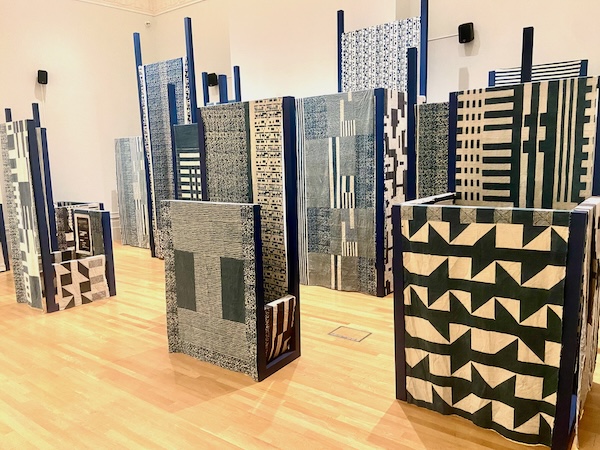
At Tate I took a photograph of an indigo-dyed textile map of the city, accompanied by a soundtrack, created by Antonio Jose Guzman and Iva Jankovic (below left, followed up later with a visit to their installation at the Walker Art Gallery, below middle and right).

Guzman and Jankovic reinterpret the history of sacred indigo textiles, which are deeply connected with colonial histories and the trade of enslaved Africans who carried the expertise of cultivating indigo with them to the Americas. The textiles feature an abstract pattern of intercultural DNA sequences that embody a global connection between the Black Atlantic…The accompanying soundscape alludes to ideas of belonging and exclusion through an exploration of diasporic sounds that combine electronic music, dub, punk, and Senegalese drums’

Messengers of the Sun

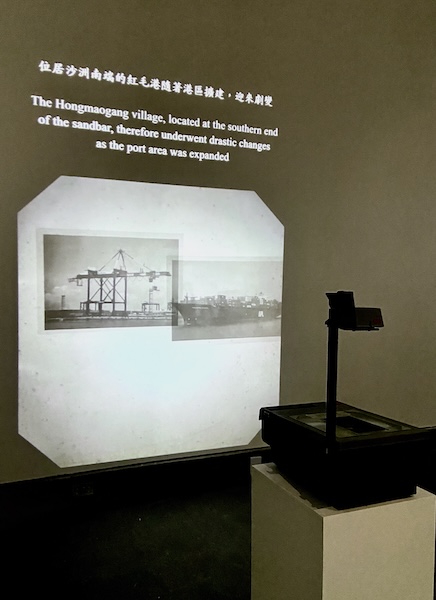
From the Tate I walked to FACT, and from FACT to Bluecoat, where ChihChung Chang‘s installation combined rubbings of manhole covers and other urban infrastructure in the shape of a Chinese arch (I had used the same technique on our walk the day before). Chang’s arch was combined with a handmade boat and projection of archive imagery, referencing ‘rapid-changing and evolving environments such as ships, islands, water and ports’.

Also at Bluecoat, was Odur Ronald’s installation Muly ‘Ate Limu/All in One Boat, made from aluminium printing plates and scrap metal:

‘The jerry cans reference the dangerous and illegal methods people sometimes use to cross seas to Europe…The arrangement of the installation references The Brooks – a renowned ship which travelled the passage from Liverpool via the West Coast of Africa, carrying over 5000 enslaved people…’

My last stop of the morning, before I travelled back to Wiltshire was the Walker Art Gallery where I came across the work of Leasho Johnson. Johnson is a Queer artist of Jamaican origin who ‘aims to disrupt perceptions around historical, political, stereotypical and biological expectations of the Black queer body.’

I realise that as a white person, I am learning about Black experience of rivers and other waterbodies from the outside, piecing a picture together through the voices and artwork of others. This post is intended as a way to publicly process and document my thinking, rather than make myself out to be some kind of expert. I’m keen to hear from others with related experiences if you’re happy to share them with me, and am particularly interested in the Black community’s relationship with the River Mersey in the present, and other Black artists/writers exploring wetlands through their work more broadly.

Thank you to Justine and UP Projects for inviting me to Liverpool to walk with The Mersey, and to everyone who joined us on the walk. And to artist friend Alys Scott-Hawkins who was my hotel breakfast buddy, and provided some of these photos of the walk, as did Lucy Caruthers, designer of spaces and experiences.

I’ve really enjoyed seeing people’s images and reflections from the walk being shared on social media, and feel happy to have created a space where people felt able to take part and record their experiences in a way that worked for them. Please do stay in touch if you’d like to, I’d love to hear from you.

After the Rain: Run off and Roadcombing

After a Summer of drought, I was wishing for some heavy rain. We had a little, then a little more, and now we’ve got the heavy stuff. As I wrote on instagram, the arrival of the rain relieves some of the tension in my body, hardened and tensed by the wait and the awareness of the damage being done to plants and animals, with the ground baked har and river levels dropping.

Temporary stream running down my road

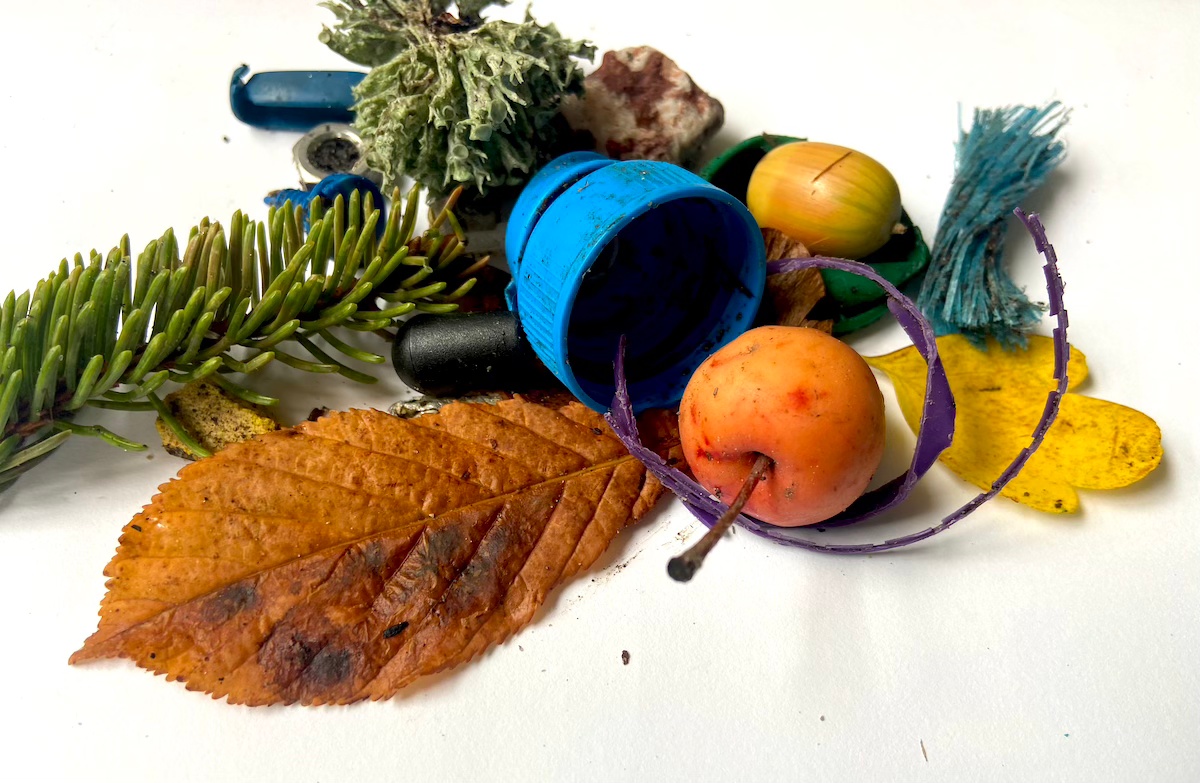
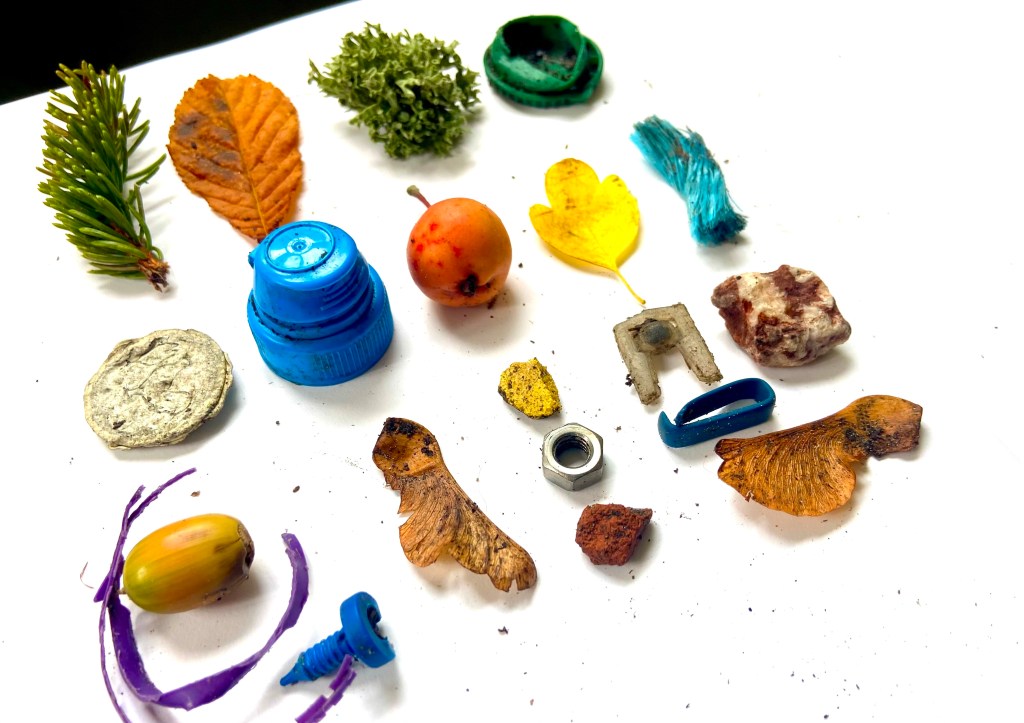
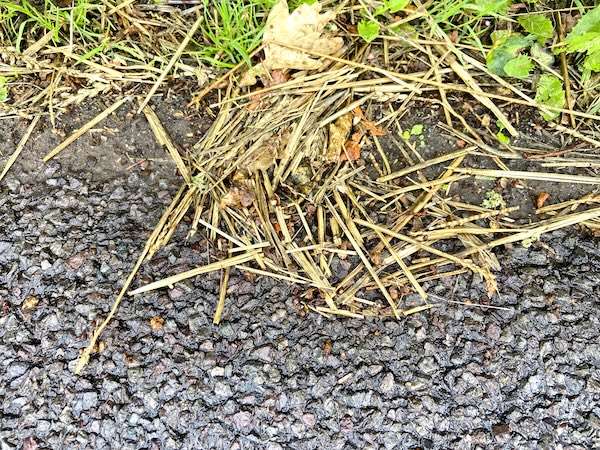
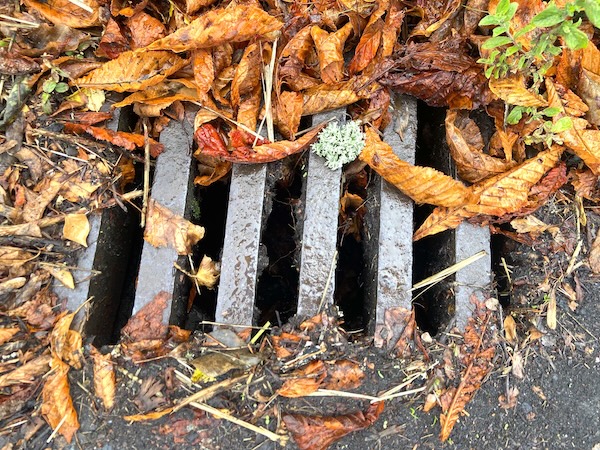
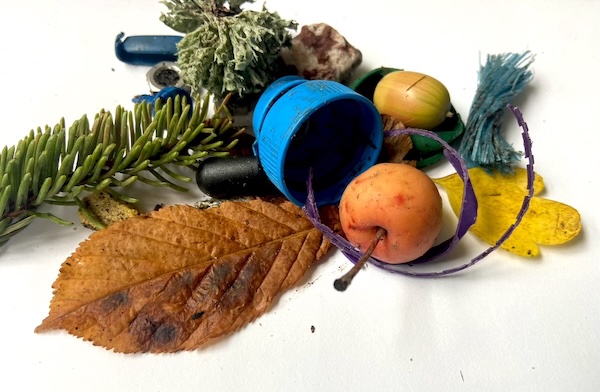
I live on a very slight hill, the continuation of the edge of Salisbury Plain, sloping down to the beginnings of the Hampshire River Avon. When rain is heavy it forms little streams down our road, heading for the river. These temporary streams leave behind clumps of straw from the recent harvest, along with plastic bottle tops and metal bits and pieces lost from vehicles, acorns and sycamore seeds.

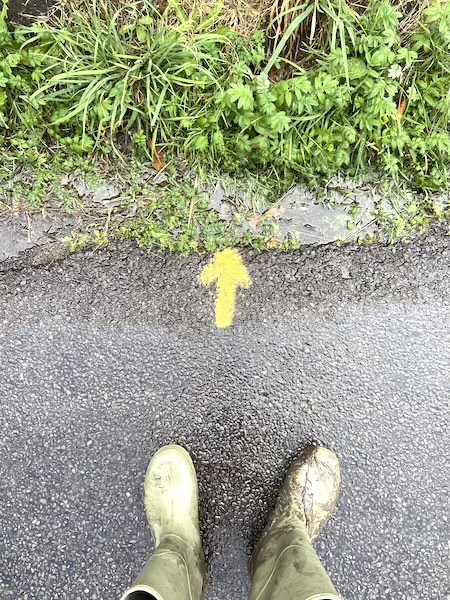
I took a walk after one of the first bursts of rain, and gathered a few things that had been washed up. I walked from my home along the road to the river bridge, tucking headlight plastic, pieces of yellow line and the odd seed or feather into my pocket. I’ve written about Roadcombing before, and the place of collecting in my practice, but not really about run off from our roads into rivers. The water is very welcome of course, and I can pick up a certain amount of rubbish, but after a long dry period what less visible stow-aways does the water carry with it?

In 2024 a white paper, produced by Keyline Civils Specialists found that:

Road runoff is responsible for 18% of waterbody failures in England (86% of the country’s inland water bodies fail to meet targets)...road runoff contains a toxic cocktail with heavy metals, including zinc, cadmium and copper, plus polycyclic aromatic hydrocarbons (PAHs) such as pyrene and benzo(a) pyrene. Microplastics and hundreds of other chemicals also routinely enter waterways in this way.

In a piece written about the paper’s findings for the Chartered Institute of Environmental Health, Professor Alex Ford of Portsmouth University said:

“We know these chemicals can be neurotoxic, immunotoxic, carcinogenic as well as reproductive toxicants.

So what about the impact on river ecosystems? John Bryden, Head of Improving Rivers at environmental charity, Thames21 adds:

“Many rivers can now only support a limited number of pollution-tolerant species due to years of accumulated contaminants. We need urgent and comprehensive action involving both the technical solutions promoted in the recent white paper and the nature-based approaches identified by our tool.’

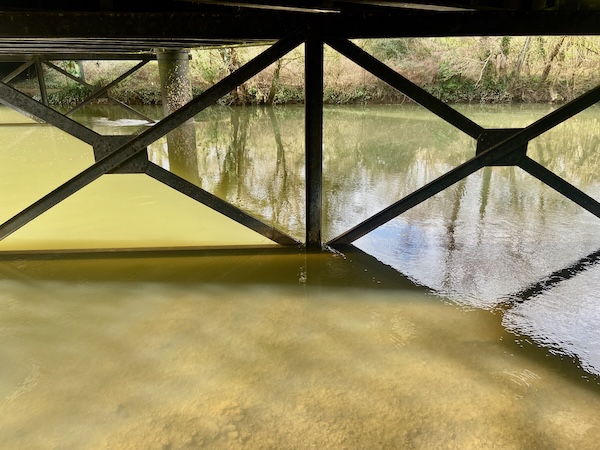
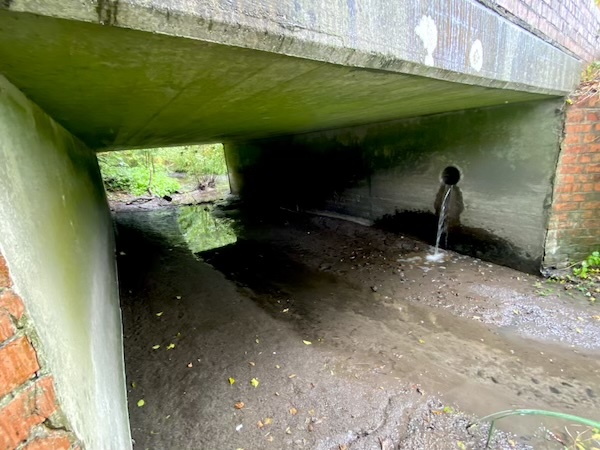
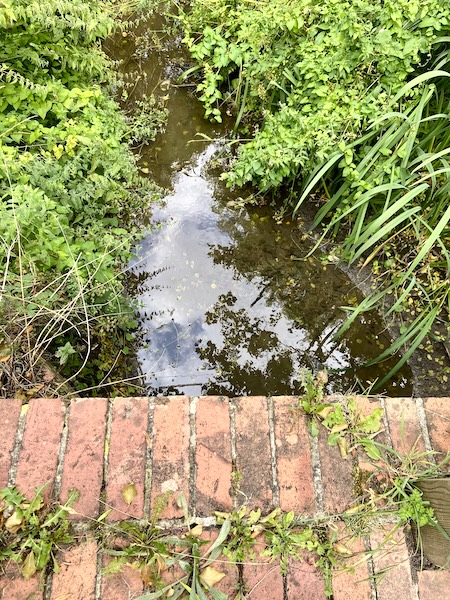
When I reached the river I climbed down to look under the bridge. It didn’t smell great. Water was pouring in from a pipe under the bridge as well as starting to flow through the river channel. Our nearest bridge has two ‘arches’, one that always has at least a trickle, and this other one that had dried up completely. It was encouraging to see a thin ribbon of water starting to make its way back to form the smaller channel, but the smell of sewage (or something like it) was pretty off-putting.

My individual, day to day artwork tends to deal with the material world, the things that I can touch and collect, or use to build or make marks. My process builds sensory awareness of environmental change. I record the footprints of animals that have passed under the bridge, or gather the feathers they’ve left behind. But hidden substances like the chemicals in road run-off are harder to notice, and so more difficult to raise awareness of. How can they be made more tangible? Is anyone doing any interesting creative or community engagement work around this? Something for me to ponder.

Tonal podcast with Feral Practice

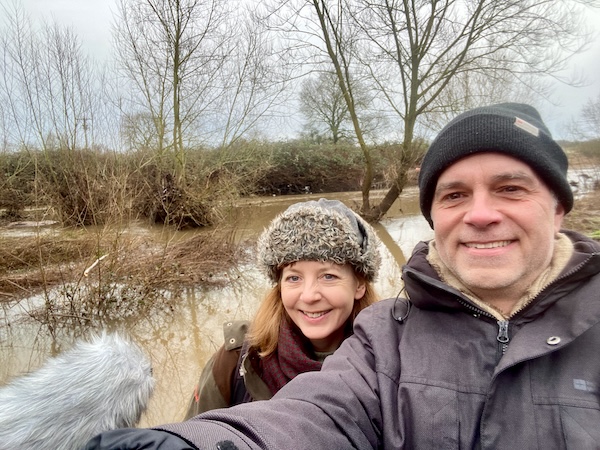
Earlier this year I walked along the flooded River Tone near Taunton, Somerset, with artist Fiona MacDonald, working with more than human communities as Feral Practice.

Fiona invited me to talk about Queer River, and explore more generally how Queer and Neurodivergent perspectives might shape our understanding of rivers.

In a similar way to Queer River, the Tonal project has seen Feral Practice bring together conversations with a diverse group of people, who have different experiences of and perspectives on rivers in general, through walking with the River Tone.

‘Tonal, by artist Feral Practice, is an audio project exploring water issues nationally with a special focus on the River Tone in Somerset. Each podcast episode is a riverside conversation with someone who has a specific personal or professional relationship to water and the river, building a broad base of knowledge from many distinctive perspectives.’

Our conversation, and others recorded in connection with the River Tone, have now been launched as the Tonal Podcast, have a listen here: https://tonal-uk.com

Re-Making Rivers: Learning from Different Perspectives

As an artist I’m interested in making, including how other species can be seen as makers, and the possibility for multi-species collaboration, including in the re-making of UK rivers that have suffered from previous human interventions.

Earlier this month I spent a few days holiday in Devon with my family. I was hoping to find time to look for signs of beavers, being in such a beaver hotspot as the Otter Valley, and maybe attempt some beaver watching if I found a good location. But I wasn’t expecting to be so surrounded by evidence of beavers right where we were staying.

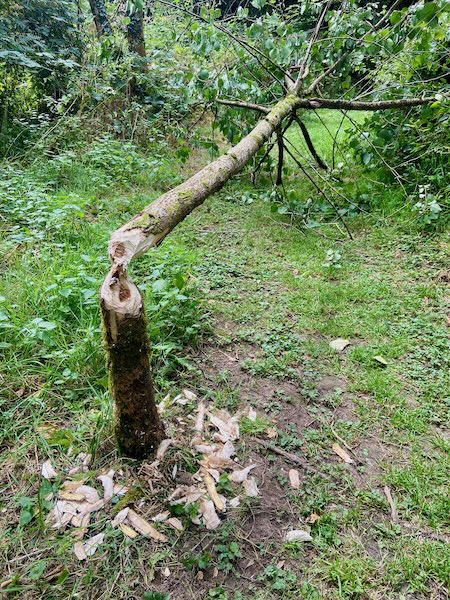
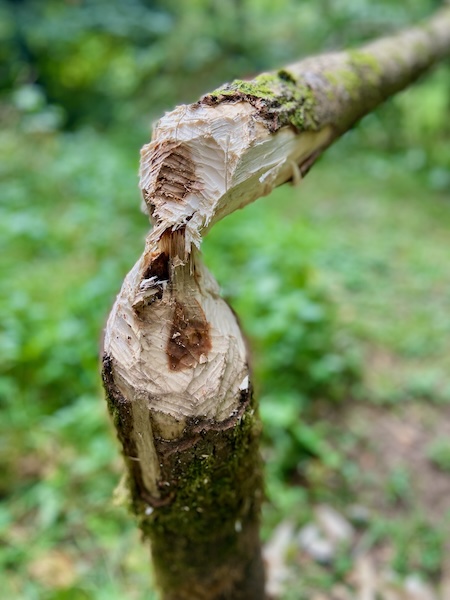
Walking around the holiday site, with some small steams/ditches and 3 small fishing lakes (our teenage son is a fishing fan), I saw signs of beavers pretty much everywhere. Small felled trees, freshly cut coppice, beaver chewed fragments on the footpath. Over the following few days I started to notice small dams in the streams and a large older one part covered over with brambles. As it got dark on the first evening I sat on the bank of one of the lakes, and a beaver came gliding along 10 feet in front of me. I made the mistake of moving to take a video and it disappeared with a huge splash and a whack of its tail.

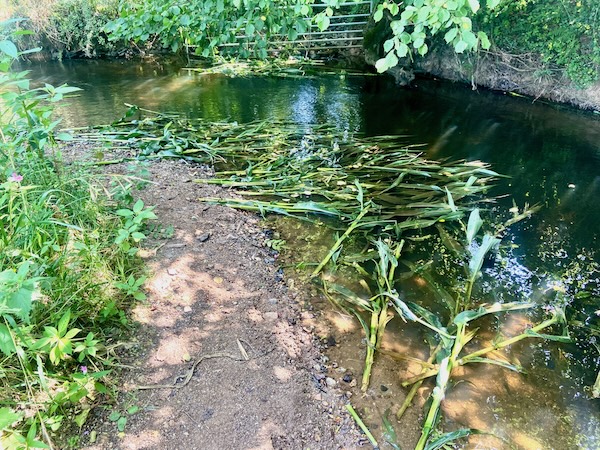
I was in beaver heaven. I saw or heard the local beavers every evening – on our last night they were hidden but I could hear them loudly chomping – and when we walked down to the nearby River Otter there were stashes of ‘harvested’ maize in the river from nearby fields, and half finished dams in the drought-lowered water.

Beavers re-make rivers with their bodies, as they gnaw wood, carry rocks, dig canals, and push/puddle earth into crevices, adapting degraded wetlands and bringing them to life. It’s not about restoration in the sense of taking rivers back to how we think they once were, but bringing them the best health and levels of biodiversity they can achieve now, in a time increasingly impacted by climate breakdown, biodiversity loss and pollution.

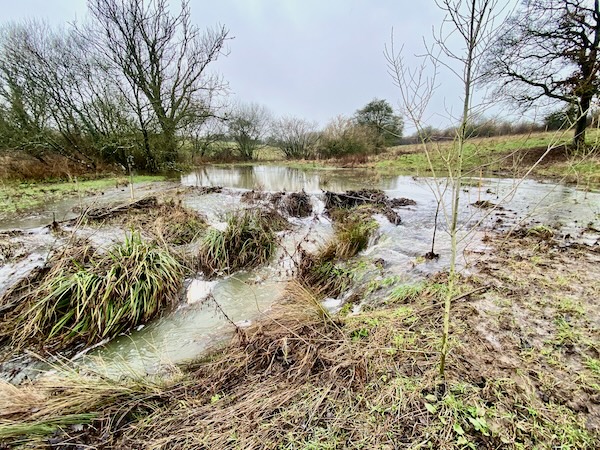
In the Norfolk Rivers Trust beaver enclosure on the River Glaven that I visited last year as part of my residency with Groundwork Gallery, the beavers had incorporated the ruins of WW2 sewage infrastructure into their own constructions (featured image and above), adding stray bricks and a muntjac deer skull to dams and lodges. Beavers work with the ‘blasted landscapes’ that we’ve created through extractive capitalism, and re-make them to the benefit of wider ecosystems.

The ruin glares at us with the horror of its abandonment. It’s not easy to know how to make a life, much less avert planetary destruction. Luckily there is still company, human and not human. We can still explore the overgrown verges of our blasted landscapes…’

Anna Lowenhaupt-Tsing

My aim is that Queer River contributes to the decolonising of the discourse on river futures. When I say this I’m very aware that I am a white person living in an industrialised, European country. I’m not claiming to have the whole story. I’m aiming to provide a space where queer, neuroqueer, non-human and other voices can come together and be heard, and where we can all learn from each other.

Indigenous voices and practices are important to my research, and I am excited about the potential for learning from reintroduced keystone species and ‘ecosystem engineers’ such as the beaver too. In my recent PhD proposal, I wondered out loud if in a country with no indigenous human population (despite what the far right may tell us), that returning beavers might bring an indigenous perspective to UK wetland creation and management, that we lost when we hunted them to extinction.

People in other cultures and the UK’s past have learned from living alongside beavers (see my previous post about beavers and bridges/trackways and the work of Bryony Coles), and now in this time of ‘renewed coexistence’ perhaps we need to do so again in new ways developed through arts based research (as river restoration has with the development of beaver dam analogues for example).

Justice is a key part of my process/practice, from environmental and disability justice, making sure that the disproportionate impacts of the environmental crisis on disabled and neurodivergent people (among others) are more widely understood and understanding the valuable insights we bring (see Neuroqueer Ecologies), to multi-species and epistemological justice, valuing different forms of knowledge and understanding and accepting that a white, western, colonising worldview was what created these problems to start with.

A lot of the figureheads of the river restoration and activism movement in the UK seem to be white men. I’m very conscious of that as a white, male-presenting person who works in environmental and outdoor learning contexts. There’s a lot of good work being done by such people and I think we also need to use our privilege to make space for other voices and experiences.

‘The modernist view treated water as simply a ‘resource’ for irrigation, water supply and sanitation. The aesthetic, cultural, spiritual, and ecological values that the local societies ascribed to water were simply occluded by this view. Under modernity rivers were a giant plumbing system carrying cubic meters/feet of water, and were expected to stay within the imposed iron limits of average flows.

Experientially for the local societies in Pakistan/India, average flows were meaningless as were cubic meter numbers. To them rivers were living entities with their moods and regimes with no two days the same. People lived and interacted with rivers like they lived and interacted with their families.’

Daanish Mustafa, Decolonising Water

For example, while I value the work that Robert MacFarlane is doing, in using his profile and writing to bring the issues of river degradation and sentience to a mainstream audience (see Is a River Alive?), I think we need to work a lot harder to explicitly acknowledge and amplify what indigenous, feminist, global majority and non-human perspectives are bringing to this work.

In this country we seem to fall back so readily into foregrounding the experience of white, male, probably straight naturalists/writers/explorers. Which other river writers and activists should we be hearing from?

There’s so much to say on this subject. I can’t fit everything I’d like to say into a single blog post, and I still have a lot to learn from others. So this is just a taste of my thinking about the need to foreground decolonial discourses, and help bring about the re-making of rivers, through a collaborative, multi-species reimagining of what a river of the future might be.


Here are some references to writing that has informed my thinking, in addition to the links in the post.

Please do suggest other reading or art/environment/comunity projects you think I might benefit from having a look at, and I’ll return to share more examples soon:

  • Chao, S and Kirksey, E (Editors) (2022): Who Benefits From Multi-Species Justice? From the book: The Promise of Multispecies Justice – Duke University Press.pp 1-17
  • van Dooren, T. Kirksey, E. and Munster, U. (2016): Multispecies Studies: Cultivating Arts of Attentiveness – Environmental Humanities (2016) 8 (1): 1–23. DOI:10.1215/22011919-3527695
  • Parsons, M, Fisher, K and Crease, R.P (2021): Decolonising River Restoration: Restoration as Acts of Healing and Expression of Rangatiratanga. Chapter 9 of the book: Decolonising Blue Spaces in the Anthropocene, Freshwater management in Aotearoa New Zealand. Palgrave MacMillan
  • Todd, Z (2015): Indigenizing the Anthropocene. From the book: Art in the Anthropocene. Encounters Among Aesthetics, Politics, Environments and Epistemologies) – Open Humanities Press. Pp 241-252
  • Tsing, A L. (2015): The Mushroom at the End of the World, On the Possibility of Life in Capitalist Ruins – Princeton University Press
  • Woelfle Hazard, C. (2022): Underflows. Queer Trans Ecologies and River Justice – University of Washington Press

A Rivery Mind / Thinking with Bridges

My work ‘out there’ (outside of my home and studio) now quietens for the Summer. I have some lovely one day events and CPD sessions I’m facilitating in August, but apart from that, life can slow down for a bit. When I am doing my work with organisations and communities I need to interpret my practice and working processes for them. I compartmentalise, and focus on specific areas and aspects that relate to that particular audience. But Queer River, although it informs and encompasses much of this work, goes beyond this segmentation. It flows where it needs to go, connecting areas that need to be connected.

I’ve recorded some really interesting conversations over the last year for different podcasts, and there’s a new one being published very soon on the About Time podcast with Chris Nichols. In it, as with most work-related conversations, Chris asks me to talk about what I do, what Queer River is, and why I have come to specialise in working with rivers and their associated communities. I can’t remember my exact answer to Chris, but I talk about my relationship with rivers as a subject, how I have always felt drawn to watery places, and been a keen amateur naturalist, I realised this morning however, that the key reason I work with rivers is because I have a Rivery Mind.

My mind flows from subject to subject, across disciplines and contexts. I think here about research from Rachel Clive about the relationship between geodiversity, neurodiversity and Freedom Space for Rivers:

‘…neurodivergent behaviours, like different river behaviours, are not defects or problems to be controlled, disciplined or eradicated, but are natural differences which engage in processes that can self-regulate, that can nurture new life, that can suggest different ways of doing things that are valuable to all, whether neurodivergent or not.’

This flowing of my mind is both Neuroqueer and Neuroqueering, it goes where it needs to go and it brings its own perspective on the world. It is wide open and hyper sensitive to sensory information and the feelings of others. Compartmentalising can be both for the benefit of others (i.e narrowing my thinking to make it easier for others to understand), and for my own employability and wellbeing (making myself safe or acceptable and more obviously relevant for people who tend to cluster their thoughts into specific areas). But what rivers give me is a model of how to be fully myself, and a dynamic structure which can hold the complexity and allow the fluidity of my practice-led research. Thinking with rivers suits my river-y mind.

This isn’t what I was going to write about today. What I was going to say is that now I have the time and space to allow my mind to not need to know what it is doing or where it is going , I can relax into walking and making, and go on a deep dive into whatever takes my fancy. And that subject that takes my fancy right now is Bridges.

Recently, I’ve been walking and cycling from my home in Wiltshire to bridges that cross the Hampshire Avon. Staying local and renewing my relationship with my home river is grounding after a busy few months of travelling and translating my ways for others. I didn’t have a specific reason for visiting bridges other than a feeling that they had something important to say, something to teach me about our relationship with rivers, and the rest of what we’ve come to call ‘Nature’. Something about power and relationship perhaps. Bridging is generally thought of a positive thing, bridging differences between communities for instance, but there’s more to it than that, and as Queering and Neuroqueering both act to blur and sit across conceptual divides, I had a feeling there might be an interesting conversation to be had about/with bridges.

This post shares the start of that conversation with bridges, and ties in directly with my work on Neuroqueer Ecologies (a term I coined a couple of years ago and a thread that weaves itself through my Queer River work). In it I deliberately let my thoughts flow, rather than overly edit and translate, as a bit of an experiment.

I don’t know how your mind works, or how much you’ll get from me sharing this current set of insights from my Rivery Mind, but it feels important to be open about how I work behind the scenes. Before I turn up ready to talk about chalk streams or lead a workshop on noticing and recording biodiversity through art, I go through a whole research process, and then then translate my knowledge and understanding from river minded-ness into something more accessible to the general public. Of course I recognise that many others I work with are neurodivergent too, and that my work is much more about dialogue than a transmission of ideas, but in a sense I am bridging worlds for the benefit of participants and commissioning organisations. It’s work I love, but it can also take a lot out of me, so remembering the value of getting back into the flow is vital.

On one of my recent bike rides in the Vale of Pewsey (something I touched on briefly in my earlier Queer River research), a chalk valley shaped by the headwaters of the Hampshire Avon, I started looking more closely at bridges. It reminded me that when I started Queer River, my plan was to walk its length with invited others. But I soon realised that access to the river is very limited, with much of the land alongside it in private ownership, and that bridges often offer the only form of access.

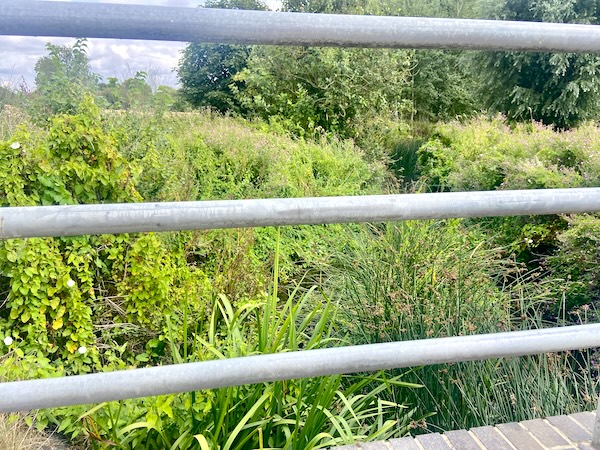
Looking over the edge of a road bridge into a river, especially with cars whizzing by, can make me feel unsafe and like I’m not meant to be there. Looking through or over barriers, I feel cut off from the river below, like watching an animal through the wire at the zoo. I’m raised up, set back and only get a tiny glimpse of a dynamic community of life. Looking down onto ‘Nature’, emphasises the cultural separation.

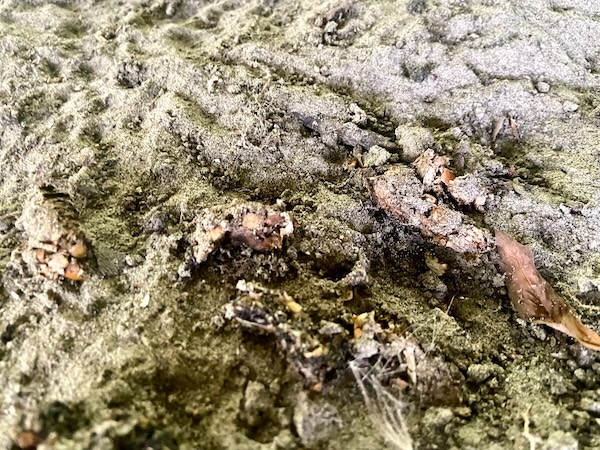
Of course, humans aren’t the only animals to use bridges. The underside of human-made bridges are often used by otters to mark territory with their spraint (the slightly fishy, jasmine-tea scented droppings they leave on rocks and bridge foundation stones.) I’ve been reading some research on how otters on my local river, and how they’ve been eating invasive American Signal Crayfish, the shells of which then turn their spraint pink. I have added a photo of said pink poo below. Not a great quality image I know, but it was taken while crawling under a low, dark bridge. If the otters can’t find a way to pass under a bridge via land, they often opt to cross the road instead, leading to road deaths and forming an barrier to otter populations returning to historic habitat (see here re the installation of a ‘mammal shelf’ under a bridge in Sussex).

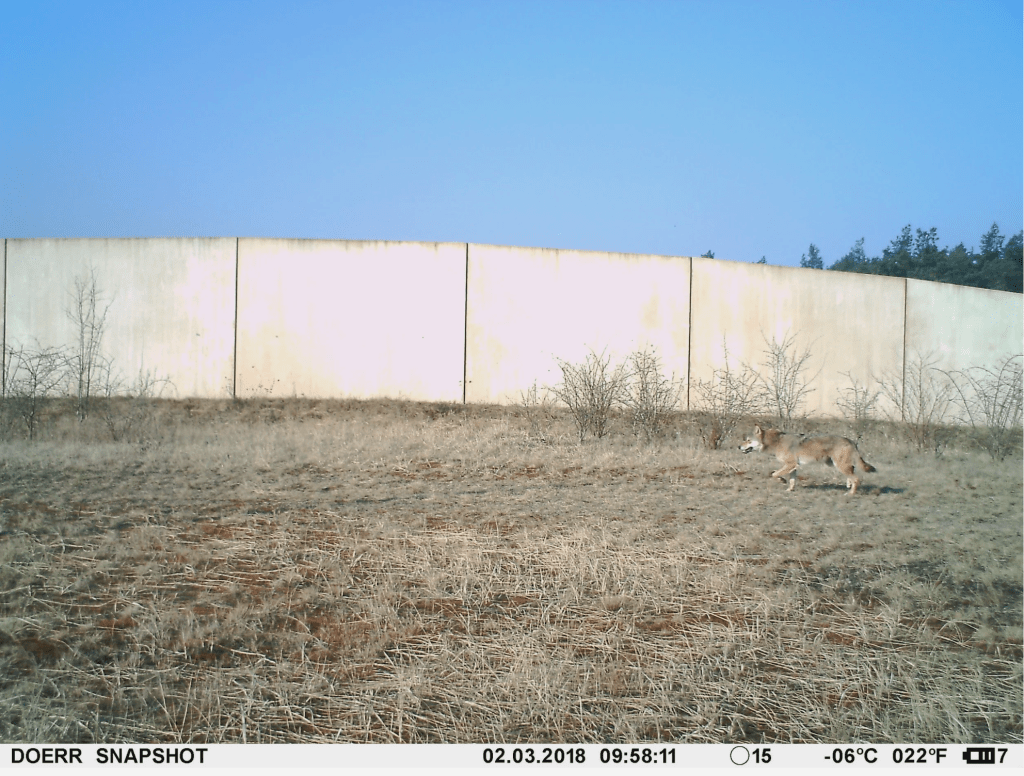
While we are talking about multi-species interactions and bridges, I’m reminded that bridges aren’t always made for people to cross (see here for an article on wolves using a Green Bridge in Germany, images also below), or indeed made by people. Archaeologist Bryony Coles in her work on Doggerland, has suggested that humans were likely to have used dams made by Eurasian Beavers as bridges across wetlands.

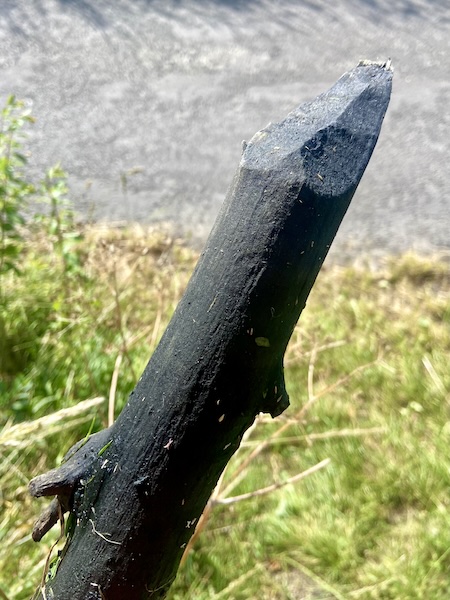
Coles also carried out research on the Somerset Levels, into the building of the Sweettrack in the Brue Valley and other wetland trackways built from wooden stakes. When researching the cut marks on these stakes, it was realised that some weren’t make by flint tools, but by beaver teeth. The humans were gathering beaver chewed lengths of wood and repurposing them to create their raised walkways, perhaps even gathering them from the beaver dams themselves. Taking from one kind of bridge to make another (the stakes would have been similar to this one I found photographed below).

It makes sense to me that humans have used beaver dams as bridges and trackways in the past, and that they learned some of their techniques from beavers, through living side by side. Youtube has some gorgeous videos (example below) of camera trap footage, showing different animals using such dams to cross boggy ground in the US and Canada. Human animals surely would have done the same thing in the UK in the past.

The simplest form of bridge of course is a fallen tree, which different animals use to cross a stream or river, avoiding getting cold and wet, or eaten by aquatic predators. Research in Poland (see here), has showed that larger mammals tend to prefer fallen trees, while small mammals preferred the interconnected wood and earth structures created by beavers. The researchers suggest that as small mammals can walk through the spaces created between the branches, they may gain protection from aerial predators.

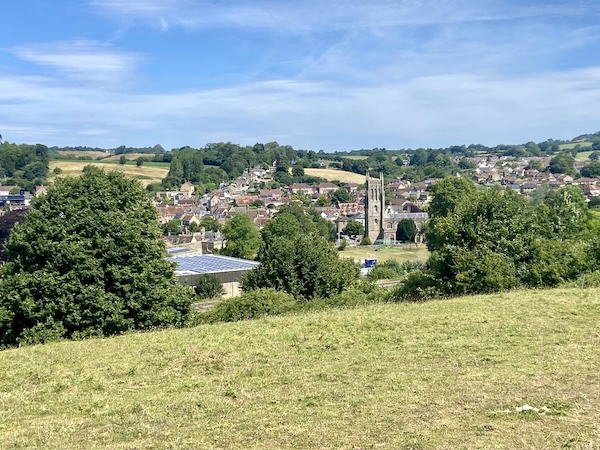
I’ve added a short clip below of a beaver dam that I recorded during a visit to the Norfolk Rivers Trust beaver reintroduction site on the River Glaven, and a photo near the end of the post of a fallen tree bridging a local tributary of the Avon near my home in Wiltshire. I plan to get a camera trap up near one of these tree bridges soon.

In September, I’m going to be leading two interactive walks. The first, with curator Justine Boussard for Up Projects in Liverpool, will draw on my Neuroqueer Ecologies research and Queer River methodologies to accompany delegates from the Bodies of Water symposium to the River Mersey, supporting them to use their bodies to notice how water moves through the city. The second, with Curator Florence Fitzgerald-Allsopp, Researcher/Geographer Joe Jukes and a local LGBTQIA+ group, will walk from Hauser and Wirth to Bruton (images below), where we will be spending a little time with the River Brue.

Flo is working with Spike Island in Bristol, and Hauser and Wirth Somerset, on an Ecotone focused fellowship, working with communities where land/water, and urban/rural meet, whilst Joe’s PhD focused on Queer Ruralities and the lived experiences of queer people in rural Somerset.

Somerset is a rich place for exploring wetlands past and future. Wild beavers have returned to the Brue in recent years and to other locations in Somerset, including the Heal Somerset rewilding site (images below), between Bruton and Frome, where I was recently invited to be part of a panel discussion on rewilding and diversity.

Somerset faces an increased risk of flooding due to Climate Breakdown, and is also shaping up to be something of a rewilding hotspot, whilst the value of beavers is increasingly recognised in managing river flows during both drought and flood. In an area that was drained for agriculture, much like the fens in east Anglia, the water is trying to return, bringing opportunities to return lost species, as well as threats to homes and current forms of agriculture (Cranes have already been reintroduced to the Levels, and discussions around the feasibility of reintroducing Dalmation Pelicans have begun).

When I’m out cycling to bridges in the Vale of Pewsey, I take a bag of materials to draw with, recording what I notice and what the river shows me. I look out for signs of wetland animals, and how they interact with man-made structures, and take the documentation of my ‘noticings’ home with me in the form of photographs, drawings and found objects.

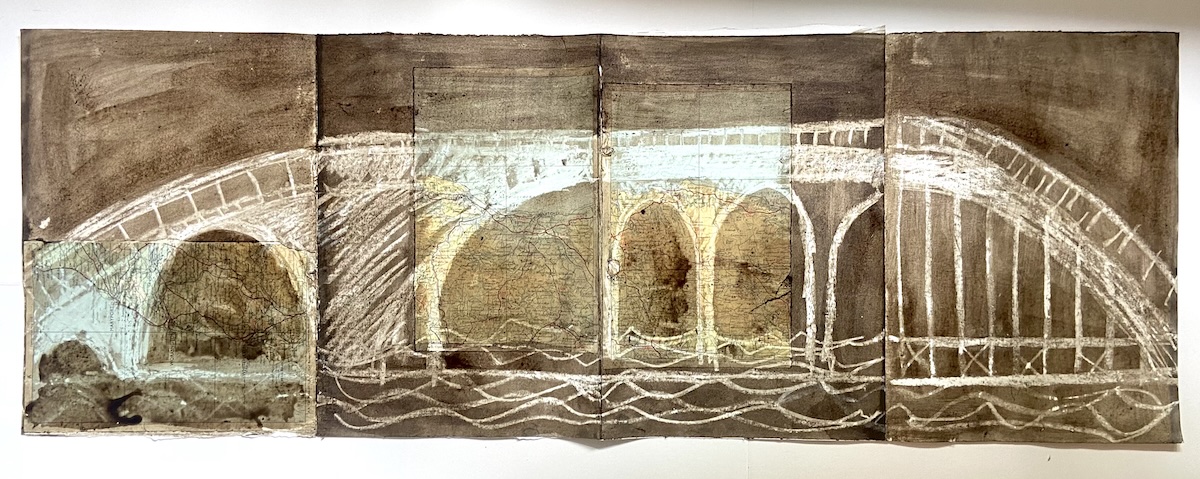
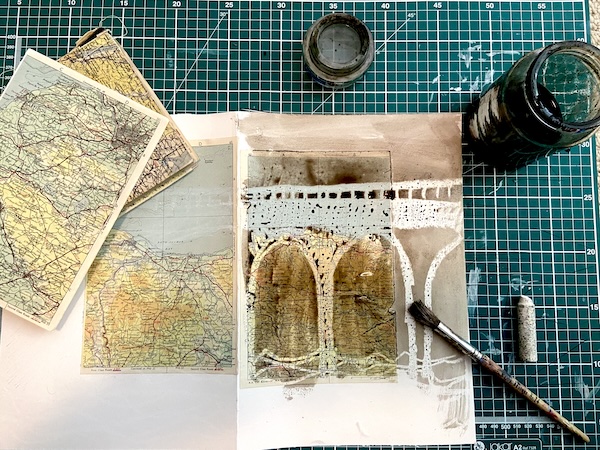
Back in my home studio I continue to play with bridge shapes and structures, through drawings that join a succession of different forms together, like a game of Exquisite Corpse. I’ve learned what I need to step into a state of flow, and how staying too long in ‘translator mode’ can fix my thoughts in too small an area, causing blockages that impact my wellbeing.

My body-mind makes sense of the world (and more specifically of rivers and our relationship with them) through this iterative process of walking, cycling, drawing, reading, writing and other forms of making, allowing elements of what I’ve noticed to sit alongside each other and find new connections, without pressure for them to ‘make sense’ in a neuronormative way.

‘…neuronormativity emphasises the idea that there is one right way to function and punishes anyone who diverges from this one right way.’

Stimpunks Foundation

Queer River offers me ways to make sense of the world that suit my body-mind, and offers perspectives on river communities that go beyond the inherited and binaried concepts that have limited our thinking and caused so much damage in the past.

Its effects on me feel like a Stage Zero river restoration project, where human built structures that straighten/block a river are removed, allowing it to find its own path through the land, with a resulting complexity of habitat and a dynamism of flow that brings greater diversity and wellbeing.

One of the values of this way of carrying out research is its open-endedness, and so I’m not going to try and tie this all up neatly now, but instead leave it open, ready to return to again, when my thinking with bridges has developed further.

If you have any thoughts to add into the mix I’d be happy to hear from you… bridges, rivers, neurodivergence, it’s all welcome. Please comment below or get in touch and let’s see where it takes us.

Bodies of Water Symposium at the Liverpool Biennial

On September 11th I’ll be facilitating a walk as part of Bodies of Water Symposium: Regenerative Arts Practice.

Titled Neuroqueer Ecologies: Noticing Differently, our walk will see us travelling as a group from Black-E to the Queen’s Wharf on the River Mersey, noticing and creatively recording how water passes through the city, informed by my research into the value of sensory and processing differences (see Neuroqueer Ecologies).


Curated by Up Projects and guest curator Justine Boussard (a fellow Associate at Climate Museum UK), the symposium brings together artists, curators, and environmentalists to discuss how public art can respond to the climate and biodiversity crises.

The symposium aims to raise the ambition for what it means to be environmentally responsible both technically and culturally as well as share learnings from UP Projects’ Bodies of Water commissions by artist Ann Dun Hee Jordan.

It will ask ‘What is the role of socially-engaged public art in the context of our accelerating environmental crisis?’ and features experts from Culture Declares Emergency, Invisible Dust, Liverpool Biennial, Julie’s Bicycle, Kings College London, Metal, Haigh Hall, Sunderland University, The Place Bureau and more.

The symposium will take place at The Black-E, 1 Great George Street, Liverpool L1 5EW from 12:30 – 18:30pm.

You can book your place here, and will be able to select my walk as your breakout session nearer the time. The walk will be limited to a maximum of 20 participants.

It’s shaping up to be a brilliant event – let me know if you’re coming!

Queer River – five years on

I set up Queer River five years ago in 2020, as we emerged from lockdown, as a way to walk, talk and make with my local river, the Hampshire Avon, which begins its journey near my home in the Vale of Pewsey in mid Wiltshire.

The original intention was to pay attention to the river on my doorstep, to slow down and really notice, and to experience the river through other people’s eyes, queering my sense of what a river is by holding a space for multiple, intersecting perspectives. I couldn’t find ways to fund the research that I wanted to do, so I set up Queer River as an independent, arts-based research project.

The River Avon a short walk from my house in Wiltshire

My time with the Hampshire Avon soon expanded to include my other local river, the Bristol Avon, whose tributaries pass near to where I live. As I walked with others, made and exhibited new artwork, and wrote about our experiences for the Queer River blog, I was invited to travel to work with other rivers and their communities across the UK (including Glasgow, Great Yarmouth and The New Forest ) .

Community engagement projects developed from my research in partnership with environmental and heritage organisations, I was commissioned to speak about my research, to write about it, and to make new artwork for exhibitions relating to watery themes, and the place of queerness within rurality and ecology.

Blue Health, the interrelationship of human and river health, and emotional wellbeing have emerged as key themes, and seen me share my research as case studies with Bristol Medical School among others. With an exploration of my neurodivergence also came a new element. Neuroqueer Ecologies now weaves itself through Queer River, researching the value that sensory and processing differences, among others, can have when sensing and experiencing connection with ecosystems.

All of these areas have multiple blog posts published here, as an archive of the work that has come before. Queer River began as a single flowing channel of work and has expanded to become multiple channels of interconnecting themes and practices. It’s not easy to explain what Queer River is, as it deliberately aims to go beyond disciplinary boundaries, beyond individuals, and to create a space for knowing rivers that it also about knowing ourselves, and facing an uncertain future.

Some people don’t yet understand the value of queer perspectives to a wider environmental movement, and see it as a niche area, something just for LGBTQIA+ people. The queer community and our relationship to climate justice has an important place within my work (see previous writing on the relationship between the AIDS crisis and Climate Crisis for example), and it also goes way beyond that. Queer River questions how we have come to the situation that we find ourselves in, environmentally, socially and culturally, whose voices and experiences are missing from the environmental movement, and what arts-based, dialogical research and community engagement can bring to an understanding of what rivers need from us in a future impacted by these multiple crises.

5 years later

This year has had some really exciting elements (including new beaver-related research, a residency with John Hansard Gallery focused on the River Itchen (image below and featured image by Nosa Malcolm), projects with Wiltshire Wildlife Trust and Well City Salisbury and talks for a range of organisations). At the same time, the arts and many artists are in a very difficult place financially. I’ve spent a lot of time and energy this year on funding, residency and commission applications, whilst politically and culturally the world has felt a much more volatile and threatening place for queer and neurodivergent people.

I felt the need to write this post as a way of gathering previous threads together, grounding myself and my practice, and re-introducing Queer River. A kind of re-launch, in a soft and gentle way.

One thing that events this year have confirmed for me, after 25 years of working within creative community engagement of various forms, is the amount of experience that I have to bring to different sectors, who are starting to realise the place of arts-based community engagement.

For example, this month I visited the Flood and Coast conference with Wessex Archaeology to share learning from The Ripple Effect project with Leigh Chalmers, and support conference delegates to envision the role that creative engagement can play in flood mitigation projects. I also contributed to a panel at Into the Light for Heal Rewilding in Somerset, sharing a little about the place of art, queerness and neurodivergence within rewilding.

What next?

I’m going to continue to work across art, climate/biodiversity and learning/wellbeing, with new projects in development, and upcoming events including leading a walk at the Bodies of Water symposium with Up Projects as part of the Liverpool Biennial, and the second Art of Rewilding event at Found Outdoors, both in September.

I’m also continuing to develop and exhibit new physical artworks (see previous solo exhibitions Drawing on Water and Neuro/Queering Nature and The Beaver and the Whale for Groundwork Gallery) and am enjoying presenting, writing and professional development becoming a key part of my work as I share my experience with others.

At the same time I want to make space for 1:1 and group walks, like my walk with Groundwork Gallery and the Norfolk Rivers Trust, or a recent walk as part of Wiltshire Museum’s Queer in Wiltshire project, and write more ‘Walking with… ‘ posts. This is how I started Queer River, and it’s a way to learn from others whilst anchoring myself and my practice in my locality.

Ultimately, I’m particularly excited about the potential for the arts and environment sectors to work together, in developing regenerative practices that value diverse experiences and perspectives on place, and I’d be happy to discuss how I can support the development and delivery of rewilding, species reintroduction and other related projects.

So, for those of you looking at Queer River for the first time, I hope this post gives a bit of insight into what it is and where its value lies. If you’d like to explore ways of working (or walking) together, please do get in touch, I’d be really pleased to hear from you.

Noticing Differently: Rivers, Bodies and Beavers

Over the last year or so I developed a PhD proposal and then applied for a studentship to fund my research. The proposal focuses on my Neuroqueer Ecologies research and applies that to human/beaver relationships, in the re-making of rivers, and within the context of climate and biodiversity crises. Put very simply, Neuroqueer Ecologies is all about the value that sensory and other differences bring to understandings of ecosystems. What we notice about different places depends on how our body-mind interacts with those places, and the beings we share them with. Neurodivergence brings value to an exploration of ecosystems (amongst other things) through noticing differently.

As part of this, and following on from my time in Norfolk last year with GroundWork Gallery and the Norfolk Rivers Trust, I have been taking a deep dive into the subject of beaver reintroduction in the UK, and the gradual recolonisation by beavers of my two local river systems, the Hampshire and Bristol Avons.

I heard yesterday that I wasn’t successful in my SWWDTP studentship application, which is a obviously a blow after so much time and energy spent researching and planning, but I still really believe in the need for this research, so I thought I’d share a little of what I’ve been up to on here, rather than keep it all to myself.

My PhD research would be practice-based, using my arts practice to map different beaver sites. I’m especially interested in the relationship between human and beaver infrastructure. How humans have altered rivers through history, and how beavers, on returning to these rivers after being hunted to extinction, are adding to, adapting or deconstructing these modifications.

As an artist and maker, who believes in the value of embodied approaches to knowing self and place, I’m interested in beavers as makers, as they use their bodies to shape riverine ecosystems. I’m also keen to draw on evidence from a past where people and beavers lived interconnected lives (e.g. through the work of archaeologists such as Bryony Coles), and crucially to learn from indigenous perspectives on multi-species, wetland communities, in an effort to decolonise the way that we relate to and restore our rivers.

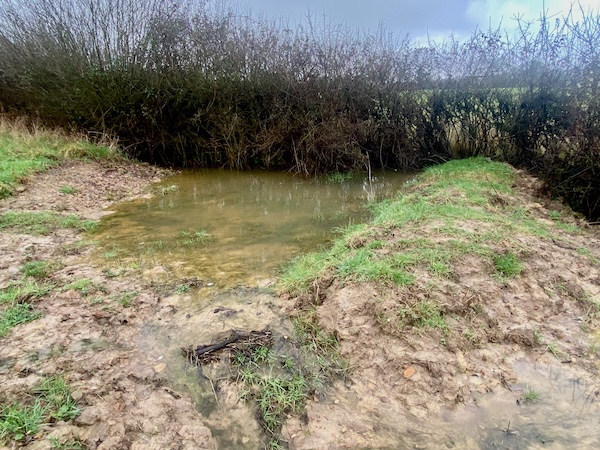
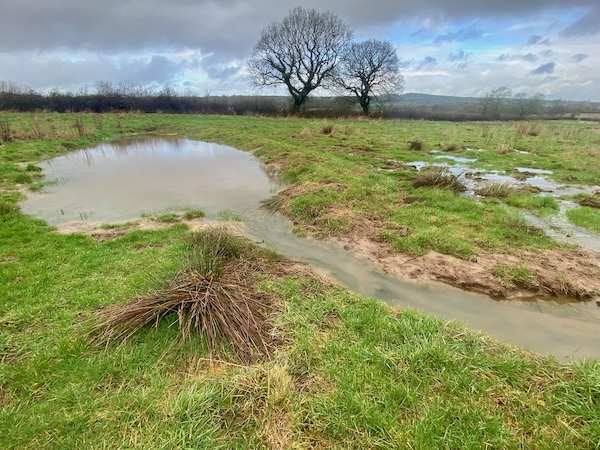
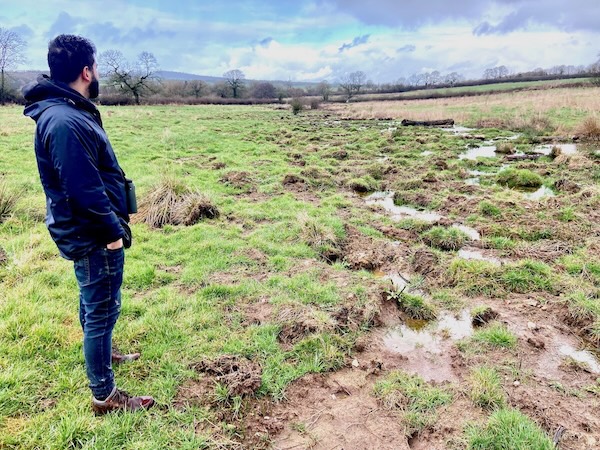
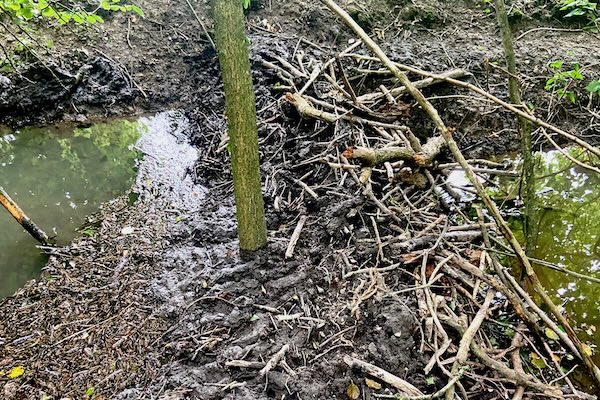
I’m not going to go into details on the specific locations where I found or heard of evidence of beavers in Wiltshire, as I don’t want to risk them being disturbed. So for this post I’m sharing some artwork I made along the River Biss in the Trowbridge area (a tributary of the Bristol Avon), and combining that with photographs of beaver signs from other Wiltshire locations.

The three sets of Walking Pages shown here document three different walks with the River Biss, between December 2024 and March 2025. These are starting points really, ways of letting the place speak to me, and noticing my response. They layer text that records what I notice in the moment, with drawings and rubbings of riverside walls/signs/manholes etc, found imagery, and objects offered up by the river.

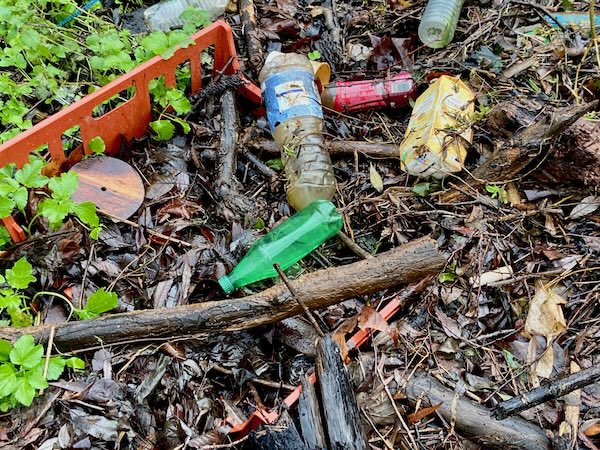
It feels important to say here just how shocked I was by the sad state of sections of the River Biss, and the huge amounts of plastic rubbish and sanitary products left behind after recent storms, especially through the town centre and downstream where the Biss meets the Bristol Avon. I was there to look for signs of the animals that we share these watery places with, but often what I was noticing were the dark, straight sided concrete channels, the piles of plastic left on the banks after high rainfall, and sanitary towels hanging from branches. I know that Wiltshire Wildlife Trust have plans for new work along the Biss, and that the Friends of Biss Meadows Country Park do a lot of good work upstream, so there are people who care and are actively seeking to change the condition of the river.

Thank you to everyone that has offered advice and support as I put my proposal together, particularly Dr Kai Syng Tan at Winchester School of Art, Dr Laura Smith and Dr Roger Auster, at Exeter University, Ecologist Gareth Harris, Dr Catherine Lamont-Robinson at Bristol University, Artist/Researcher Emily Wilkinson and the PaC Artist Network. I will be exploring other funding options over the coming months. As with Queer River, which itself grew out of writing proposals for a series of unsuccessful funding applications, I’ve started this work now, I just need the funds to make it sustainable.