
As an artist I’m interested in making, including how other species can be seen as makers, and the possibility for multi-species collaboration, including in the re-making of UK rivers that have suffered from previous human interventions.
Earlier this month I spent a few days holiday in Devon with my family. I was hoping to find time to look for signs of beavers, being in such a beaver hotspot as the Otter Valley, and maybe attempt some beaver watching if I found a good location. But I wasn’t expecting to be so surrounded by evidence of beavers right where we were staying.
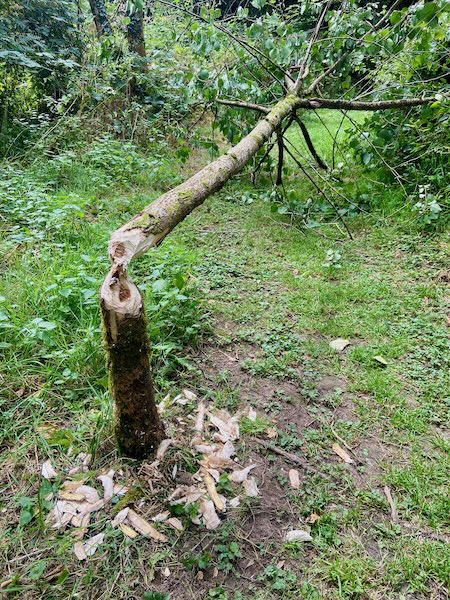
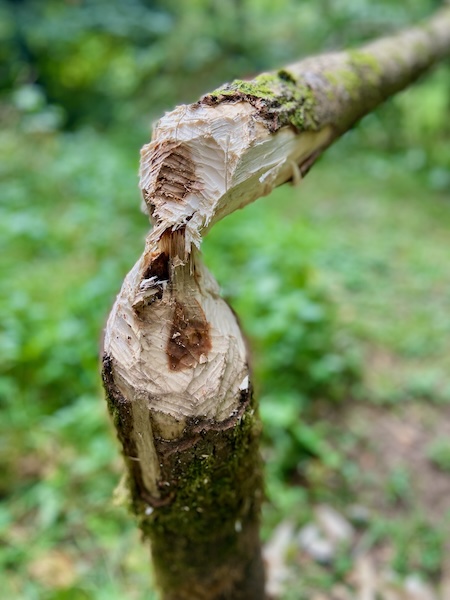
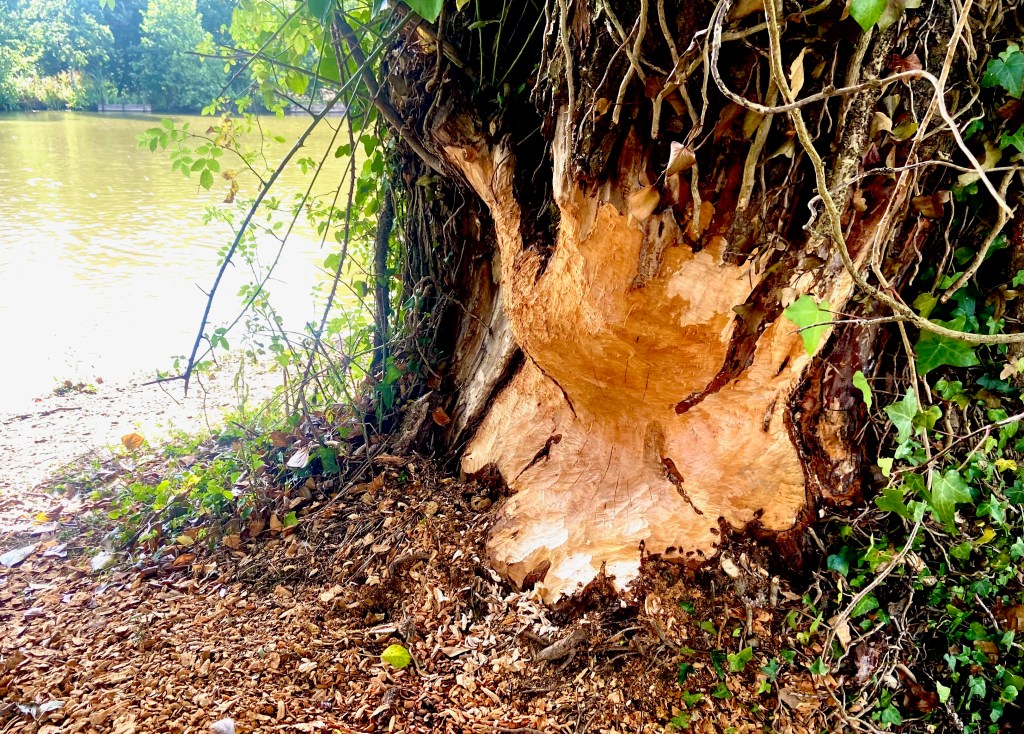
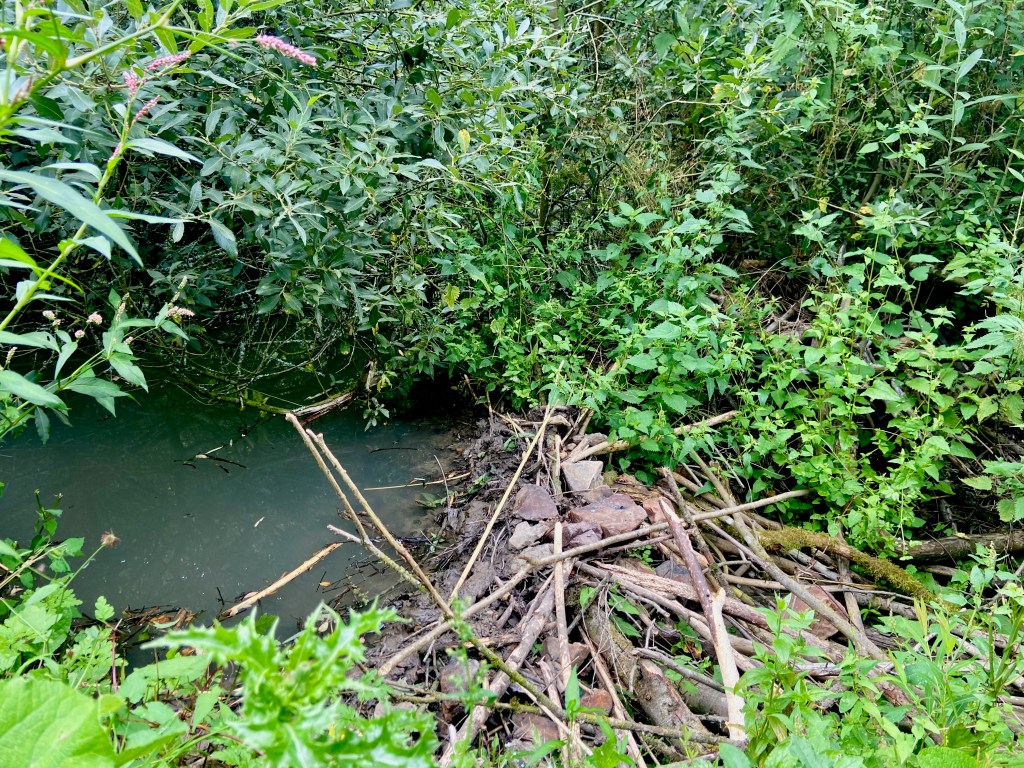
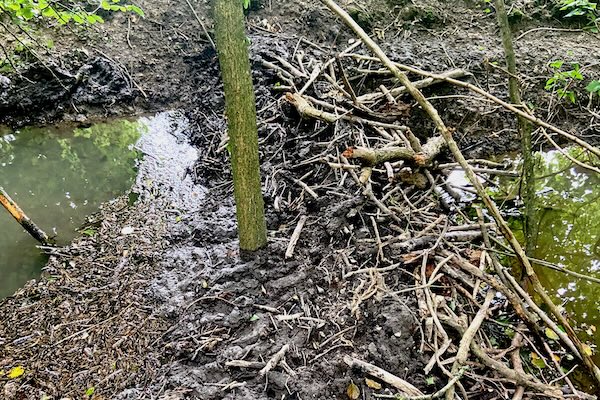
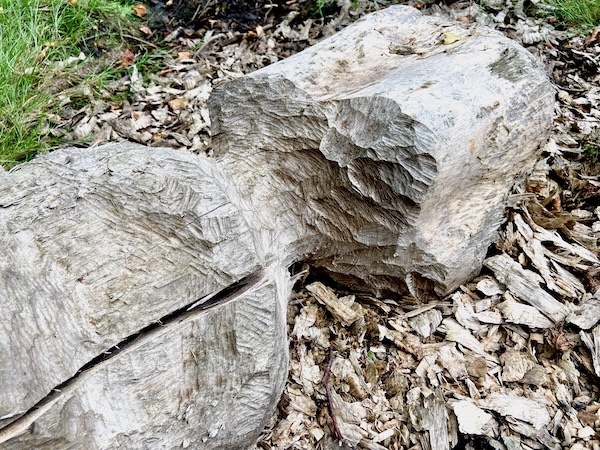
Walking around the holiday site, with some small steams/ditches and 3 small fishing lakes (our teenage son is a fishing fan), I saw signs of beavers pretty much everywhere. Small felled trees, freshly cut coppice, beaver chewed fragments on the footpath. Over the following few days I started to notice small dams in the streams and a large older one part covered over with brambles. As it got dark on the first evening I sat on the bank of one of the lakes, and a beaver came gliding along 10 feet in front of me. I made the mistake of moving to take a video and it disappeared with a huge splash and a whack of its tail.
I was in beaver heaven. I saw or heard the local beavers every evening – on our last night they were hidden but I could hear them loudly chomping – and when we walked down to the nearby River Otter there were stashes of ‘harvested’ maize in the river from nearby fields, and half finished dams in the drought-lowered water.
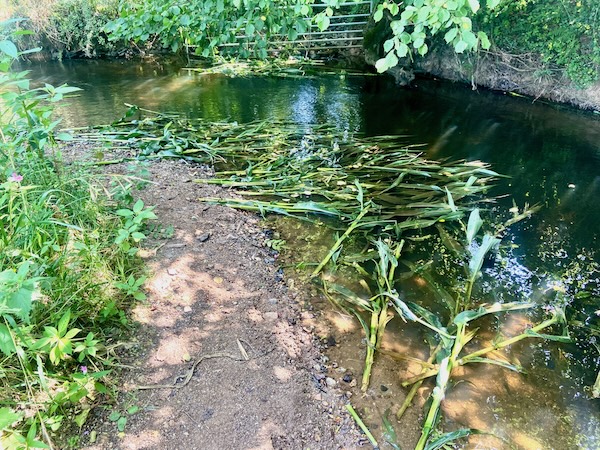
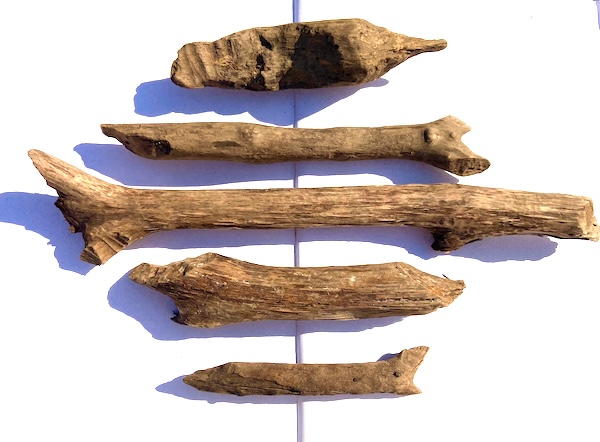
Beavers re-make rivers with their bodies, as they gnaw wood, carry rocks, dig canals, and push/puddle earth into crevices, adapting degraded wetlands and bringing them to life. It’s not about restoration in the sense of taking rivers back to how we think they once were, but bringing them the best health and levels of biodiversity they can achieve now, in a time increasingly impacted by climate breakdown, biodiversity loss and pollution.

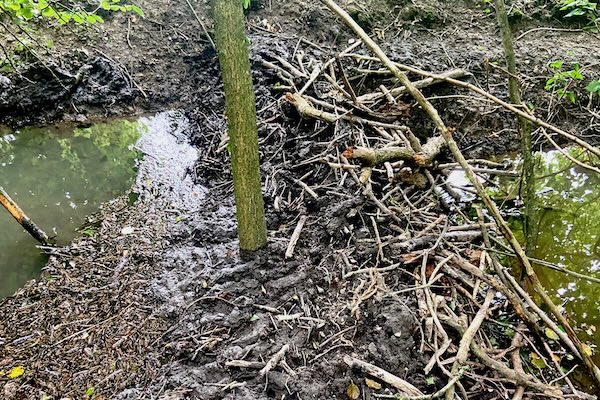
In the Norfolk Rivers Trust beaver enclosure on the River Glaven that I visited last year as part of my residency with Groundwork Gallery, the beavers had incorporated the ruins of WW2 sewage infrastructure into their own constructions (featured image and above), adding stray bricks and a muntjac deer skull to dams and lodges. Beavers work with the ‘blasted landscapes’ that we’ve created through extractive capitalism, and re-make them to the benefit of wider ecosystems.
‘The ruin glares at us with the horror of its abandonment. It’s not easy to know how to make a life, much less avert planetary destruction. Luckily there is still company, human and not human. We can still explore the overgrown verges of our blasted landscapes…’
Anna Lowenhaupt-Tsing
My aim is that Queer River contributes to the decolonising of the discourse on river futures. When I say this I’m very aware that I am a white person living in an industrialised, European country. I’m not claiming to have the whole story. I’m aiming to provide a space where queer, neuroqueer, non-human and other voices can come together and be heard, and where we can all learn from each other.


Indigenous voices and practices are important to my research, and I am excited about the potential for learning from reintroduced keystone species and ‘ecosystem engineers’ such as the beaver too. In my recent PhD proposal, I wondered out loud if in a country with no indigenous human population (despite what the far right may tell us), that returning beavers might bring an indigenous perspective to UK wetland creation and management, that we lost when we hunted them to extinction.
People in other cultures and the UK’s past have learned from living alongside beavers (see my previous post about beavers and bridges/trackways and the work of Bryony Coles), and now in this time of ‘renewed coexistence’ perhaps we need to do so again in new ways developed through arts based research (as river restoration has with the development of beaver dam analogues for example).
Justice is a key part of my process/practice, from environmental and disability justice, making sure that the disproportionate impacts of the environmental crisis on disabled and neurodivergent people (among others) are more widely understood and understanding the valuable insights we bring (see Neuroqueer Ecologies), to multi-species and epistemological justice, valuing different forms of knowledge and understanding and accepting that a white, western, colonising worldview was what created these problems to start with.
A lot of the figureheads of the river restoration and activism movement in the UK seem to be white men. I’m very conscious of that as a white, male-presenting person who works in environmental and outdoor learning contexts. There’s a lot of good work being done by such people and I think we also need to use our privilege to make space for other voices and experiences.
‘The modernist view treated water as simply a ‘resource’ for irrigation, water supply and sanitation. The aesthetic, cultural, spiritual, and ecological values that the local societies ascribed to water were simply occluded by this view. Under modernity rivers were a giant plumbing system carrying cubic meters/feet of water, and were expected to stay within the imposed iron limits of average flows.
Experientially for the local societies in Pakistan/India, average flows were meaningless as were cubic meter numbers. To them rivers were living entities with their moods and regimes with no two days the same. People lived and interacted with rivers like they lived and interacted with their families.’
Daanish Mustafa, Decolonising Water
For example, while I value the work that Robert MacFarlane is doing, in using his profile and writing to bring the issues of river degradation and sentience to a mainstream audience (see Is a River Alive?), I think we need to work a lot harder to explicitly acknowledge and amplify what indigenous, feminist, global majority and non-human perspectives are bringing to this work.
In this country we seem to fall back so readily into foregrounding the experience of white, male, probably straight naturalists/writers/explorers. Which other river writers and activists should we be hearing from?
There’s so much to say on this subject. I can’t fit everything I’d like to say into a single blog post, and I still have a lot to learn from others. So this is just a taste of my thinking about the need to foreground decolonial discourses, and help bring about the re-making of rivers, through a collaborative, multi-species reimagining of what a river of the future might be.
Here are some references to writing that has informed my thinking, in addition to the links in the post.
Please do suggest other reading or art/environment/comunity projects you think I might benefit from having a look at, and I’ll return to share more examples soon:
- Chao, S and Kirksey, E (Editors) (2022): Who Benefits From Multi-Species Justice? From the book: The Promise of Multispecies Justice – Duke University Press.pp 1-17
- van Dooren, T. Kirksey, E. and Munster, U. (2016): Multispecies Studies: Cultivating Arts of Attentiveness – Environmental Humanities (2016) 8 (1): 1–23. DOI:10.1215/22011919-3527695
- Mustafa, D. (2022): Decolonising Water, Decolonise Geography. 10th September 2022 [Blog] Available at https://decolonisegeography.com/blog/2022/09/decolonising-water/
- Neimanis, A. (2019): Bodies of Water. Postman Feminist Phenomenology – Bloomsbury
- Parsons, M, Fisher, K and Crease, R.P (2021): Decolonising River Restoration: Restoration as Acts of Healing and Expression of Rangatiratanga. Chapter 9 of the book: Decolonising Blue Spaces in the Anthropocene, Freshwater management in Aotearoa New Zealand. Palgrave MacMillan
- Todd, Z (2015): Indigenizing the Anthropocene. From the book: Art in the Anthropocene. Encounters Among Aesthetics, Politics, Environments and Epistemologies) – Open Humanities Press. Pp 241-252
- Tsing, A L. (2015): The Mushroom at the End of the World, On the Possibility of Life in Capitalist Ruins – Princeton University Press
- Woelfle Hazard, C. (2022): Underflows. Queer Trans Ecologies and River Justice – University of Washington Press
 Queer River
3 thoughts on “Re-Making Rivers: Learning from Different Perspectives”